Neural Rendering in Gaming: A Look at Real-time Graphics Advancements Over the Last 6 Months

How would you like to receive it?
Select the option that suits you best.
The gaming industry is no stranger to rapid evolution, constantly pushing the boundaries of what’s visually possible. In the last six months, one technology has been rapidly gaining traction and reshaping our understanding of real-time graphics: Neural Rendering Gaming. This revolutionary approach, powered by artificial intelligence and machine learning, is moving beyond traditional rendering pipelines to create visuals with unprecedented realism and efficiency. It’s not just an incremental improvement; it’s a paradigm shift that promises to redefine how games are made and experienced.
For decades, game developers have meticulously crafted every polygon, texture, and light source to construct virtual worlds. This labor-intensive process, while yielding impressive results, has inherent limitations in scalability and realism. Enter neural rendering, a technique that leverages neural networks to generate images, often from sparse input data, synthesizing photorealistic scenes that can be indistinguishable from reality. The implications for Neural Rendering Gaming are profound, affecting everything from character models and environmental details to lighting and animation.
The past half-year has seen a flurry of research papers, technological demonstrations, and even early integrations of neural rendering techniques into game development workflows. This article delves into these pivotal advancements, exploring the core concepts, the challenges faced, and the exciting future that Neural Rendering Gaming promises. We’ll examine how these innovations are making real-time graphics more dynamic, responsive, and breathtakingly realistic than ever before.
Understanding Neural Rendering: The AI Backbone of Future Graphics
At its heart, neural rendering uses deep learning models to generate images. Unlike traditional rendering, which relies on explicit geometric models, textures, and physics-based lighting equations, neural rendering learns to create visuals directly from data. Imagine feeding a neural network thousands of images of a specific object or environment from various angles and lighting conditions. The network then learns the underlying structure and appearance, enabling it to synthesize new views or even novel scenarios that were never explicitly programmed.
This data-driven approach is particularly powerful because it can capture complex visual phenomena – like intricate reflections, subtle subsurface scattering, and highly detailed volumetric effects – that are computationally expensive or incredibly difficult to model with traditional methods. For Neural Rendering Gaming, this means a leap in visual fidelity without necessarily requiring exponentially more artist time or computational power from the player’s hardware. Instead, the heavy lifting of ‘learning’ the visual properties is done offline, and the learned model is then used for real-time generation.
The core components often involve neural radiance fields (NeRFs), neural implicit representations, and generative adversarial networks (GANs). NeRFs, in particular, have been a game-changer, capable of reconstructing 3D scenes from 2D images and rendering them from any viewpoint with stunning photorealism. While initially slow to train and render, recent optimizations have dramatically improved their real-time performance, making them increasingly viable for interactive applications like gaming. The ability to reconstruct and render complex scenes with such fidelity is a cornerstone of the advancements we’ve witnessed in Neural Rendering Gaming.
Breakthroughs in Real-time Neural Rendering for Gaming
The last six months have been especially exciting for real-time applications of neural rendering. One of the primary hurdles has always been the computational cost. While neural networks can generate incredible visuals, doing so at 60 frames per second or higher, especially on consumer-grade hardware, has been a significant challenge. However, recent innovations have begun to crack this code.
Optimized Neural Radiance Fields (NeRFs)
Traditional NeRFs, while visually impressive, were notoriously slow to render. Researchers and developers have introduced various optimizations, such as Instant NGP (Neural Graphics Primitives) by NVIDIA, which significantly speeds up both training and rendering times. Instant NGP, for instance, can train a high-quality NeRF in seconds and render it in real-time, opening up new possibilities for incorporating captured real-world environments directly into games. This means developers can scan a real-world location and almost instantly have a photorealistic, explorable 3D model in their game engine, a monumental step for environmental design in Neural Rendering Gaming.
Neural Implicit Representations for Objects and Characters
Beyond environments, neural implicit representations are also revolutionizing how individual objects and characters are modeled. Instead of meshes and textures, these methods represent geometry and appearance as continuous functions learned by neural networks. This allows for incredibly detailed and smooth surfaces, dynamic levels of detail, and even procedural generation of variations. Companies are exploring how to use these representations to create more lifelike NPCs (Non-Player Characters) with dynamic expressions and clothing that reacts realistically to movement and environmental factors, pushing the boundaries of character realism in Neural Rendering Gaming.
AI-Powered Upscaling and Frame Generation
While not strictly neural rendering in the sense of generating entire scenes, AI-powered upscaling technologies like DLSS (Deep Learning Super Sampling) and FSR (FidelityFX Super Resolution) have become indispensable in modern gaming. These technologies use neural networks to upscale lower-resolution frames to higher resolutions with impressive quality, often generating intermediate frames to boost frame rates. The advancements in these areas have made high-fidelity gaming accessible to a wider range of hardware and are often seen as a complementary technology to full-blown Neural Rendering Gaming, providing immediate performance benefits while the more complex rendering techniques mature.
Impact on Game Development Workflows
The integration of Neural Rendering Gaming techniques is poised to profoundly impact game development workflows. Traditionally, creating high-fidelity assets is a time-consuming and expensive process. Artists spend countless hours modeling, texturing, rigging, and animating. Neural rendering could automate or significantly accelerate many of these steps.
Faster Asset Creation and Photogrammetry Integration
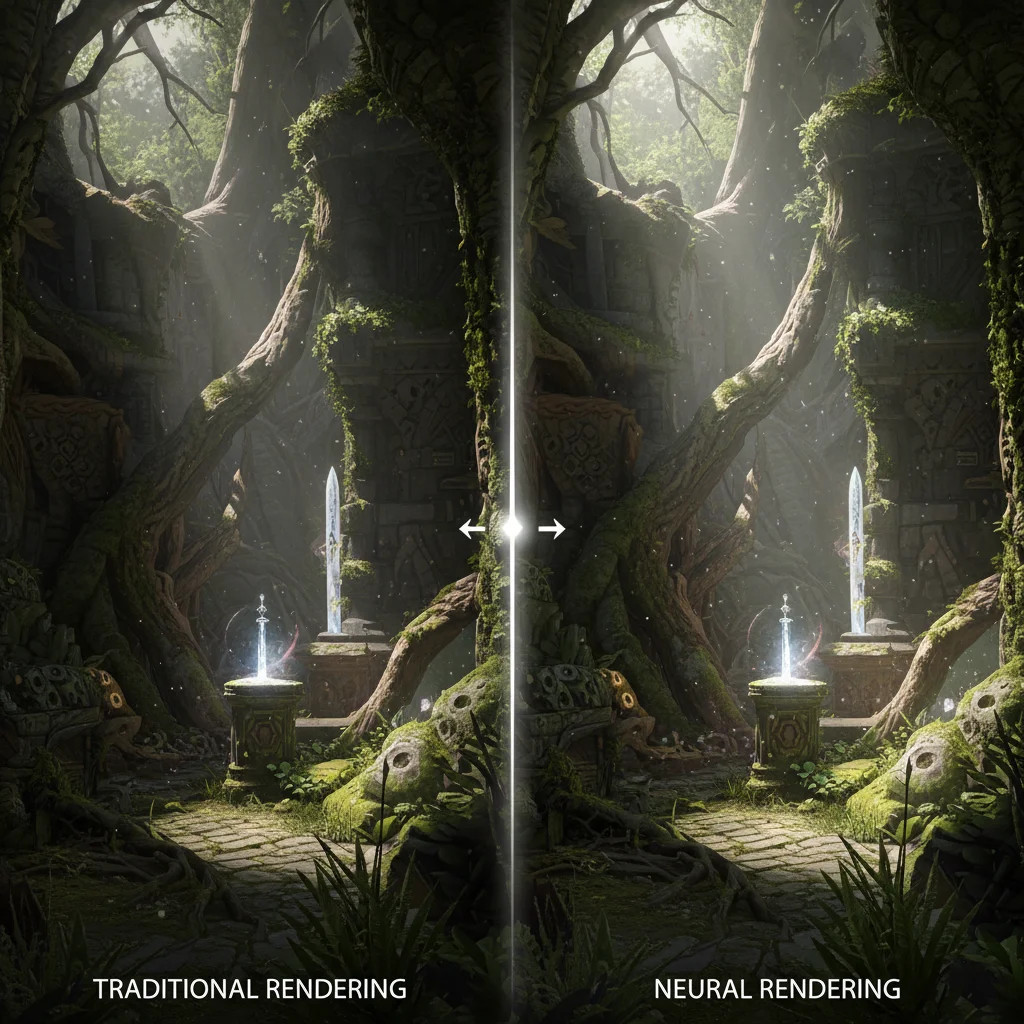
With optimized NeRFs, developers can capture real-world objects and environments using photogrammetry and quickly convert them into game-ready assets with unparalleled realism. This drastically reduces the manual effort involved in creating highly detailed environments and props. Imagine scanning a forest and having a perfectly textured, lit, and explorable digital twin ready for your game in a fraction of the time it would take to model it by hand. This efficiency gain is a massive advantage for studios looking to create expansive, detailed worlds without ballooning budgets, directly impacting the economics of Neural Rendering Gaming.
Dynamic Content Generation
Neural networks can also be used for dynamic content generation, meaning parts of the game world or even specific visual elements could be generated on the fly. This opens up possibilities for endlessly varied environments, procedurally generated quests with unique visual elements, or even adaptive storytelling where the visuals change based on player choices. The ability to dynamically synthesize visuals could lead to games that feel more alive and less ‘pre-baked,’ offering unprecedented replayability and immersion. This dynamism is a key promise of advanced Neural Rendering Gaming.
Reduced Storage and Bandwidth
Another often-overlooked benefit is the potential for reduced storage requirements. Instead of storing massive texture maps and complex geometric models, neural rendering can store compact neural network models that can synthesize the visual data when needed. This could lead to smaller game install sizes, faster download times, and more efficient streaming of assets, improving the overall player experience and easing the load on game distribution platforms. The efficiency gains extend beyond just rendering performance, influencing the entire ecosystem of Neural Rendering Gaming.
Challenges and Hurdles for Widespread Adoption
Despite the incredible promise, Neural Rendering Gaming still faces several challenges before widespread adoption becomes a reality. These hurdles range from technical complexities to practical considerations for game developers and players alike.
Computational Demands and Hardware Requirements
While significant progress has been made in optimizing neural rendering for real-time, it still demands substantial computational resources, particularly GPU power. For many of these techniques to run smoothly on a wide range of consumer hardware, further optimizations and specialized hardware acceleration (e.g., dedicated AI cores) will be necessary. Ensuring that players with mid-range systems can still enjoy games leveraging neural rendering is crucial for market penetration.
Integration with Existing Game Engines
Current game engines like Unreal Engine and Unity have highly optimized, mature rendering pipelines built around traditional rasterization and ray tracing. Integrating neural rendering seamlessly into these complex systems requires significant engineering effort. Developers need robust tools, clear workflows, and standardized APIs to effectively incorporate neural rendering assets and techniques without disrupting existing pipelines. The learning curve for artists and programmers also needs to be managed.
Data Acquisition and Training
Neural networks are only as good as the data they are trained on. Acquiring high-quality, diverse datasets for training neural rendering models can be time-consuming and expensive. For game environments, this might involve extensive photogrammetry captures. For character animation, it could mean motion capture data and detailed scans. The process of generating, curating, and managing these datasets is a new challenge for game studios venturing into Neural Rendering Gaming.
Artistic Control and Predictability
Artists often prefer explicit control over every detail of their creations. Neural rendering, being data-driven and sometimes opaque in its internal workings, can feel less predictable. Ensuring that artists can still guide and fine-tune the output of neural rendering models to match their artistic vision is essential. Developing intuitive tools that allow for creative control over AI-generated visuals will be key to gaining widespread acceptance among the creative workforce.
The Future of Neural Rendering in Gaming: What’s Next?
Looking ahead, the trajectory of Neural Rendering Gaming is undeniably exciting. The pace of innovation suggests that within the next few years, these techniques will move from experimental research into mainstream game titles. Here’s what we can anticipate:
Hybrid Rendering Pipelines
Rather than completely replacing traditional rendering, neural rendering is more likely to be integrated into hybrid pipelines. Certain elements, like complex volumetric effects, highly detailed distant environments, or specific character features, might be handled by neural networks, while other aspects continue to use optimized traditional methods or ray tracing. This allows developers to leverage the strengths of each approach, achieving optimal visual quality and performance.
Truly Dynamic and Interactive Worlds
Imagine game worlds that dynamically adapt to player actions, not just in terms of gameplay mechanics, but visually. Neural rendering could enable environments to procedurally generate new areas, objects, or even entire biomes on the fly based on narrative choices or player exploration. This could lead to genuinely unique playthroughs for every player, significantly enhancing immersion and replayability.
AI-Powered Character Animation and Interaction
Beyond static appearances, neural networks are already being used to generate realistic character animations and facial expressions. In the future, Neural Rendering Gaming could lead to NPCs with incredibly lifelike movements, dynamic clothing simulations, and even AI-driven facial animations that respond subtly to dialogue and emotional cues, making character interactions far more believable and engaging.
Personalized Visual Experiences
Could neural rendering allow for personalized visual styles? Perhaps players could choose a ‘filter’ or ‘artistic style’ that a neural network applies to the game world in real-time, transforming the aesthetics from photorealistic to painterly, or even abstract. While speculative, the underlying technology has the potential to offer unprecedented customization of visual experiences.
Enhanced VR/AR Experiences
Virtual and Augmented Reality stand to benefit immensely from neural rendering. The ability to generate highly realistic 3D content from sparse data, coupled with efficiency gains, could lead to more immersive and believable VR/AR environments that are less demanding on hardware, making these experiences more accessible and widespread. The challenge of rendering complex scenes at high frame rates for VR is perfectly suited for the optimizations offered by Neural Rendering Gaming.
Conclusion: The Dawn of a New Visual Era in Gaming
The last six months have underscored that Neural Rendering Gaming is not just a theoretical concept but a rapidly maturing technology with tangible applications. From optimized NeRFs enabling real-time photogrammetry to neural implicit representations creating unprecedented detail, the advancements are transforming what we thought was possible in real-time graphics. While challenges remain in terms of computational demands, integration, and artistic control, the trajectory is clear: AI-powered rendering is here to stay.
As developers continue to experiment and innovate, and as hardware capabilities grow, we can expect to see neural rendering techniques become increasingly common, leading to games that are not only visually stunning but also more dynamic, immersive, and efficient to produce. The future of gaming graphics is being painted by neural networks, and it promises to be a canvas of unparalleled realism and creativity. Get ready for a new era of visual experiences, driven by the relentless march of Neural Rendering Gaming.