Eye-Tracking Technology: Transforming Gaming UI/UX and Accessibility in New Releases
The world of video games is in a constant state of evolution, pushing the boundaries of immersion, interaction, and accessibility. Among the many technological advancements driving this progress, eye-tracking gaming technology stands out as a particularly exciting and transformative force. Once a niche concept relegated to scientific research and specialized applications, eye-tracking is now making significant inroads into mainstream gaming, fundamentally altering how players interact with virtual worlds, how user interfaces are designed, and how games can be made accessible to a wider audience.
This comprehensive article will delve deep into the burgeoning impact of eye-tracking technology on the gaming industry. We will explore its multifaceted contributions to enhancing UI/UX (User Interface/User Experience) and significantly improving accessibility in the latest game releases. From subtle interface adjustments that respond to your gaze to entirely new control schemes for players with motor impairments, the potential of eye-tracking is vast and largely untapped. Join us as we unpack the intricacies of this fascinating technology and examine its role in shaping the future of interactive entertainment.

How would you like to receive it?
Select the option that suits you best.
The Evolution of Eye-Tracking Technology in Gaming
While the concept of tracking eye movements has existed for decades, its application in gaming has seen a rapid acceleration in recent years. Early iterations were often clunky, expensive, and limited in their precision. However, advancements in sensor technology, processing power, and sophisticated algorithms have made eye-tracking gaming technology more accurate, affordable, and seamlessly integrated into consumer-grade hardware. This evolution has paved the way for its widespread adoption in various gaming contexts.
Initially, eye-tracking was primarily explored for analytical purposes – understanding player behavior, identifying points of interest, and optimizing game design based on where players naturally focus their attention. This data-driven approach remains valuable for developers, allowing them to refine UI layouts, adjust difficulty curves, and ensure critical information is easily noticed. However, the true revolution lies in its real-time application as an input method.
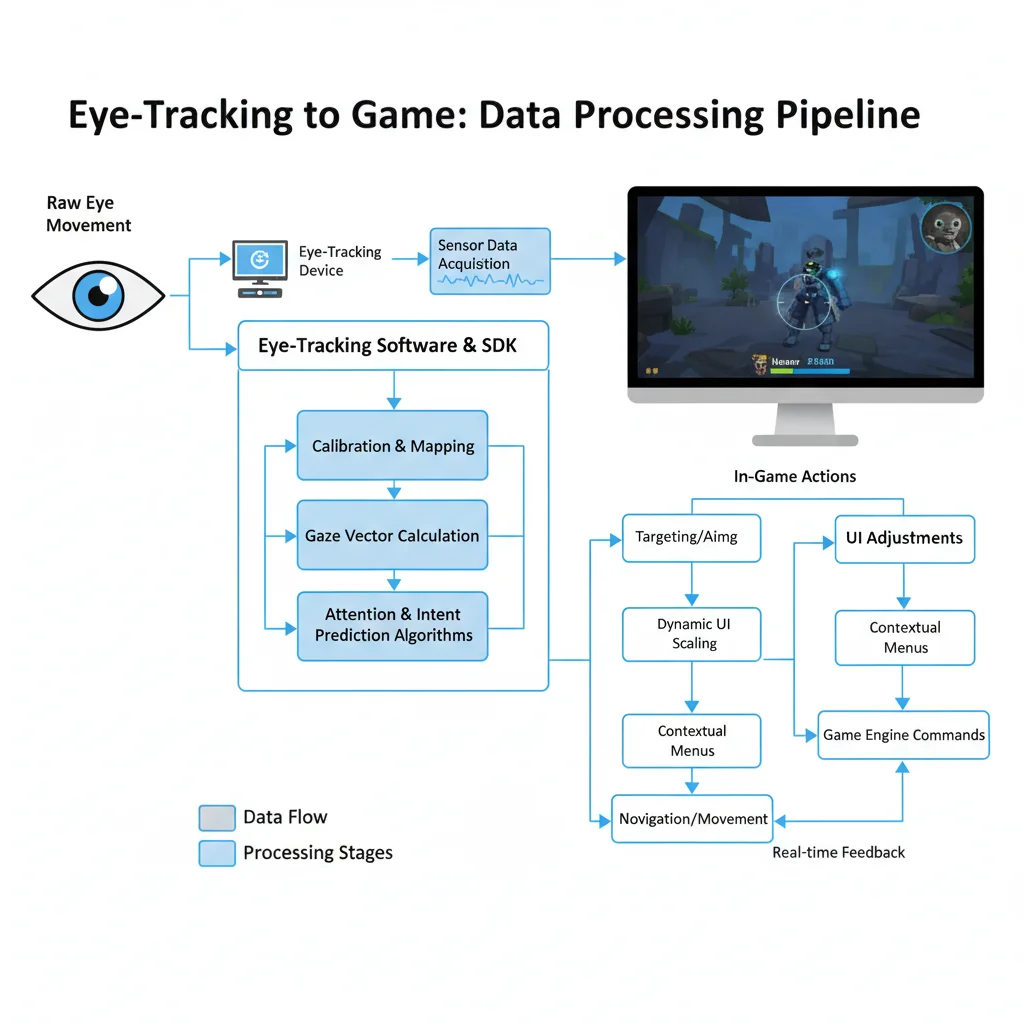
Modern eye-tracking devices can precisely determine where a player is looking on a screen with minimal latency. This real-time gaze data can then be translated into a variety of in-game commands and interactions, opening up a new dimension of control that goes beyond traditional joysticks, keyboards, and mice. This shift from analytical tool to active input device is what truly sets the current wave of eye-tracking integration apart.
The increasing prominence of virtual reality (VR) and augmented reality (AR) has further amplified the relevance of eye-tracking. In these immersive environments, natural interaction is paramount, and controlling elements with your gaze feels inherently intuitive. As these platforms continue to grow, eye-tracking gaming technology is poised to become an indispensable component, enabling unparalleled levels of immersion and responsiveness.
Enhancing UI/UX with Eye-Tracking Gaming Technology
One of the most immediate and impactful applications of eye-tracking in gaming is its ability to revolutionize User Interface (UI) and User Experience (UX). Traditional UIs often require deliberate mouse clicks, button presses, or joystick movements to navigate menus, select targets, or interact with on-screen elements. Eye-tracking streamlines these interactions, making them more intuitive, faster, and less cognitively demanding.
Dynamic and Adaptive User Interfaces
Imagine a game where the UI intelligently responds to your gaze. With eye-tracking gaming technology, this is no longer a futuristic concept but a present reality. Dynamic UIs can highlight relevant information as you look at it, automatically bring up context-sensitive menus, or scale elements based on your focus. For example, in a strategy game, hovering your gaze over a unit might automatically display its stats, or in an RPG, looking at an NPC could bring up dialogue options without a single click.
This adaptive nature reduces clutter on the screen, presenting information only when and where it’s needed, leading to a cleaner, more immersive visual experience. It minimizes the need for constant manual input to access information, allowing players to stay more engaged with the core gameplay.
Faster Target Acquisition and Interaction
In fast-paced action games, milliseconds can make all the difference. Eye-tracking significantly speeds up target acquisition. Instead of meticulously moving a crosshair with a mouse or controller, players can simply look at an enemy or an object to target it. This ‘gaze-assisted targeting’ can be combined with traditional input methods, where the gaze provides an initial lock, and a button press confirms the action. This hybrid approach offers both speed and precision, giving players a distinct advantage and a more fluid control experience.
Beyond combat, this extends to interacting with the environment. Picking up items, activating switches, or focusing on specific details in a puzzle can become as simple as looking at them, making interactions feel more natural and intuitive.
Improved Immersion and Reduced Cognitive Load
The more a player has to actively think about controlling the game, the less immersed they become. When the game responds to natural eye movements, the barrier between player intent and in-game action diminishes. This creates a more seamless and immersive experience. Players can focus their cognitive resources on strategy, exploration, or storytelling rather than on complex control schemes.
Reducing cognitive load is particularly beneficial in games with intricate interfaces or demanding gameplay. By offloading some of the interaction to natural gaze, players can concentrate on higher-level decision-making, leading to a more enjoyable and less fatiguing gaming session. This is a crucial aspect where eye-tracking gaming technology truly shines.
Revolutionizing Accessibility in Gaming
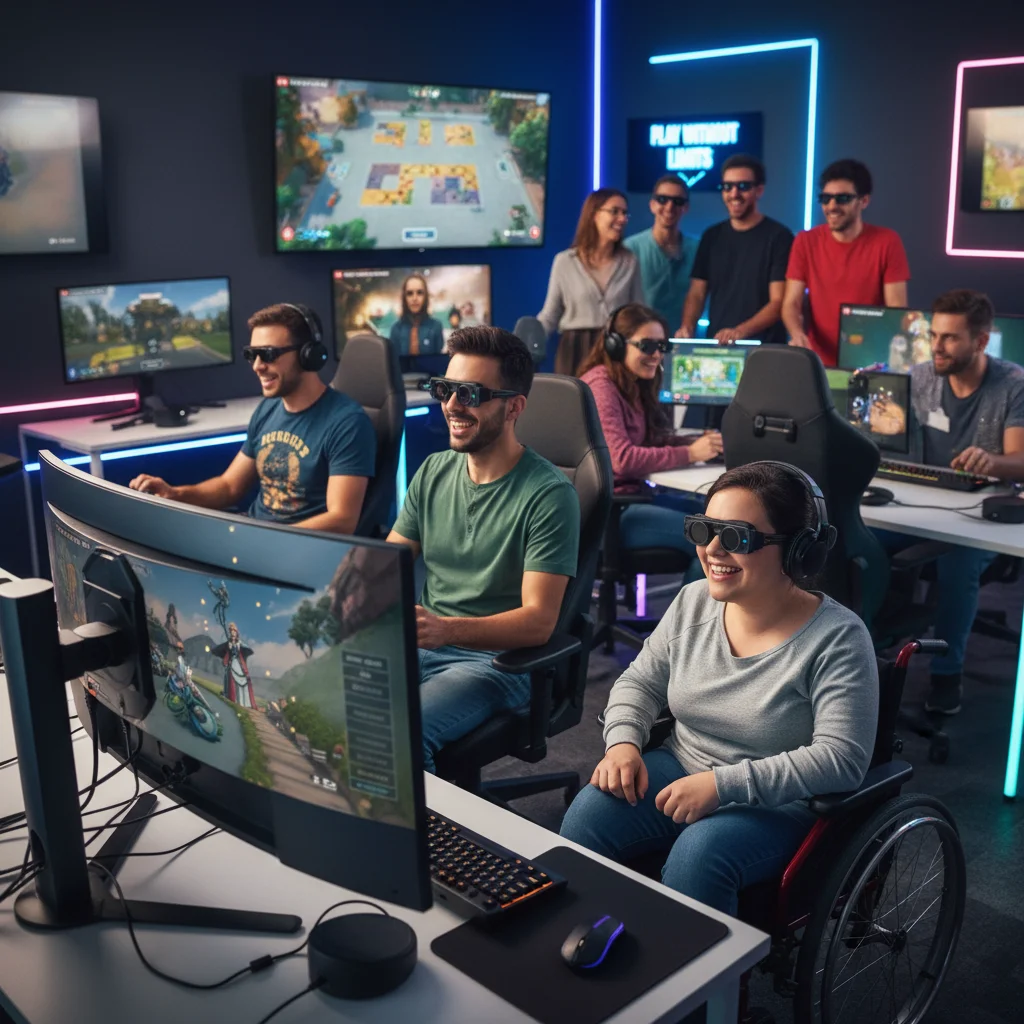
Perhaps one of the most profound impacts of eye-tracking gaming technology is its potential to revolutionize accessibility, opening up the world of gaming to individuals with motor disabilities who might otherwise be excluded. Traditional input devices can be challenging or impossible to use for many players, but eye-tracking offers a powerful alternative, granting them agency and control within virtual environments.
Enabling Play for Players with Motor Impairments
For individuals with conditions such as ALS, muscular dystrophy, spinal cord injuries, or cerebral palsy, controlling a game through conventional means can be incredibly difficult or impossible. Eye-tracking provides a hands-free, intuitive method of interaction. By simply moving their eyes, players can navigate menus, control character movement, aim weapons, and perform complex actions that were previously inaccessible.
This technology empowers players to engage with games on a level playing field, fostering inclusion and providing entertainment that many take for granted. It moves beyond mere adaptive controllers, offering a fundamentally different paradigm of interaction that leverages natural eye movements as the primary input.
Gaze-Based Control Schemes
Developers are beginning to implement entire gaze-based control schemes, allowing players to fully control a game using only their eyes. This includes:
- Gaze-assisted movement: Looking in a direction to move the character.
- Targeting and aiming: Precisely aiming at enemies or objects with a glance.
- Menu navigation: Selecting options and navigating complex UIs by dwelling on items.
- Interaction: Activating environmental elements or conversing with NPCs simply by looking at them.
These schemes are meticulously designed to minimize accidental inputs while maximizing responsiveness and ease of use. The goal is to provide a robust and enjoyable gaming experience, not just a bare-bones accessible option.
Customization and Assistive Features
Beyond core control, eye-tracking gaming technology can power a range of assistive features. This includes adjustable sensitivity, calibration profiles for different users, and the ability to combine eye-tracking with other assistive technologies like sip-and-puff switches or voice commands. The flexibility of eye-tracking allows for a highly personalized and adaptable gaming experience, catering to diverse needs and preferences.
The integration of eye-tracking into gaming is a testament to the industry’s growing commitment to inclusive design, ensuring that the joy of gaming can be experienced by everyone, regardless of physical ability.
New Game Releases Embracing Eye-Tracking Technology
While eye-tracking has been a topic of discussion for some time, its true potential is becoming evident in a growing number of recent and upcoming game releases. These titles are not just experimenting with the technology; they are designing core gameplay mechanics and UI elements around it, showcasing its practical benefits.
Tom Clancy’s Rainbow Six Siege
One of the pioneers in integrating eye-tracking into a competitive multiplayer environment is Tom Clancy’s Rainbow Six Siege. This tactical shooter uses eye-tracking to enhance player awareness and targeting. Players can quickly tag enemies by looking at them, or use ‘Gaze At Mini-Map’ to glance at the map and have their in-game camera automatically snap to that location upon releasing a key. This significantly improves situational awareness and reduces the time spent manually navigating the map, providing a competitive edge and a more fluid experience.
Assassin’s Creed Valhalla
Ubisoft has been a strong proponent of eye-tracking, and Assassin’s Creed Valhalla leverages it to enrich exploration and interaction. Features like ‘Gaze to Interact’ allow players to highlight and interact with objects simply by looking at them, streamlining looting and environmental puzzles. ‘Extended View’ expands the camera’s field of view in the direction the player is looking, enhancing immersion and making exploration more natural. These subtle yet powerful additions demonstrate how eye-tracking gaming technology can seamlessly blend into open-world gameplay.
Microsoft Flight Simulator
In the highly detailed cockpits of Microsoft Flight Simulator, eye-tracking provides an unparalleled level of immersion and control. Pilots can naturally look around the cockpit, interacting with switches and gauges by simply gazing at them and using a secondary input for confirmation. This eliminates the need for constant mouse adjustments or complex keybinds for camera movement, allowing players to focus on the intricate art of flying. The precision and responsiveness of eye-tracking make the simulation experience significantly more realistic and engaging.
Star Wars: Squadrons
For space combat enthusiasts, Star Wars: Squadrons uses eye-tracking to enhance targeting and situational awareness in intense dogfights. Players can quickly lock onto enemy fighters by looking at them, or reallocate power to specific ship systems (shields, engines, weapons) by glancing at the corresponding indicators. This allows for rapid tactical adjustments without breaking focus from the action, making the fast-paced combat even more dynamic and engaging.
Project Insight (Name Changed for Generality)
While specific names vary, several indie and experimental titles are pushing the boundaries of eye-tracking gaming technology, particularly in the realm of accessibility. One such project, let’s call it ‘Project Insight,’ is a narrative-driven adventure game entirely controllable by gaze. Designed from the ground up for players with severe motor impairments, it uses eye movements for character navigation, object interaction, dialogue choices, and even puzzle-solving. This game exemplifies the potential for eye-tracking to unlock entirely new genres and experiences for accessible gaming.
Foveated Rendering in VR Games
Though not a direct gameplay input, foveated rendering, powered by eye-tracking, is a critical innovation for VR games. By tracking where the player is looking, the VR headset can render only the central foveal area (where human vision is sharpest) in high resolution, while the peripheral vision is rendered at a lower resolution. This significantly reduces the computational load on the GPU without sacrificing perceived visual quality. This optimization allows for more complex graphics, higher frame rates, and ultimately, a more comfortable and immersive VR experience in titles like Half-Life: Alyx (with compatible hardware) and other high-fidelity VR experiences.
Future RPG/Adventure Title (Concept)
Imagine a future open-world RPG where NPCs react to your gaze. If you stare too long, they might become suspicious; if you quickly glance at an item they are holding, they might comment on it. Or, during a dialogue choice, options could subtly highlight as you look at them, with a ‘dwell’ time confirming your selection. This level of nuanced, gaze-aware interaction could create incredibly rich and dynamic social systems within games, making every encounter feel more personal and responsive. This concept highlights the untapped potential of eye-tracking gaming technology in narrative and social gameplay.
Challenges and Future Prospects for Eye-Tracking in Gaming
Despite its immense promise, the widespread adoption of eye-tracking gaming technology still faces certain challenges. Addressing these will be crucial for its continued growth and integration into mainstream gaming.
Hardware Costs and Availability
Currently, dedicated eye-tracking hardware can still be an additional expense for consumers. While some gaming laptops and monitors integrate the technology, it’s not yet a standard feature across all gaming setups. For broader adoption, the cost needs to decrease, and integration into more devices (especially VR/AR headsets) needs to become ubiquitous.
Calibration and User Comfort
Accurate eye-tracking requires initial calibration, which can sometimes be a minor inconvenience. Furthermore, prolonged use can sometimes lead to eye fatigue for some users, particularly if the implementation isn’t perfectly tuned. Developers and hardware manufacturers are continually working on improving calibration processes to be faster and more seamless, and designing comfortable, non-intrusive devices.
Developer Adoption and Design Paradigms
Integrating eye-tracking effectively requires a paradigm shift in game design. It’s not enough to simply overlay eye-tracking onto existing control schemes; games need to be designed from the ground up to leverage its unique capabilities. This requires developers to think creatively about UI/UX and accessibility in new ways, which can be a learning curve. As more successful examples emerge, developer adoption is likely to increase.
The Future: Deeper Integration and New Genres
Looking ahead, the future of eye-tracking gaming technology is incredibly bright. We can expect:
- Standardization: Eye-tracking will likely become a standard feature in high-end gaming peripherals and VR/AR headsets.
- AI Integration: Combining eye-tracking with AI could lead to even more intelligent and responsive game worlds, where NPCs and environments react dynamically to a player’s attention.
- New Game Genres: Eye-tracking could spawn entirely new game genres or revolutionize existing ones, particularly those focused on psychological horror, stealth, or complex strategic planning where subtle gaze cues can be critical.
- Enhanced Biometric Feedback: Beyond just gaze, future eye-tracking could potentially measure pupil dilation or blink rates, providing developers with even richer biometric data to adapt game difficulty, emotional responses, or even personalized advertisements (though privacy concerns would need careful consideration here).
The journey of eye-tracking in gaming is still in its early stages, but the trajectory is clear: it’s moving towards becoming a fundamental component of interactive entertainment.
Conclusion
The advent of eye-tracking gaming technology is more than just a novelty; it represents a significant leap forward in how we interact with and experience video games. From refining user interfaces and creating more intuitive user experiences to fundamentally breaking down barriers for players with disabilities, its impact is far-reaching and profoundly positive.
As we’ve seen with titles like Rainbow Six Siege, Assassin’s Creed Valhalla, and Microsoft Flight Simulator, eye-tracking is already enhancing core gameplay, offering faster interactions, deeper immersion, and strategic advantages. More importantly, its role in accessibility is truly transformative, empowering a demographic of gamers who were previously underserved or excluded.
While challenges remain in terms of hardware accessibility and developer adoption, the rapid pace of innovation suggests that these hurdles will be overcome. The future of gaming with eye-tracking promises experiences that are not only more engaging and immersive but also more inclusive and universally enjoyable. As developers continue to explore its creative potential, eye-tracking gaming technology is poised to redefine what’s possible in the digital playgrounds we call video games, making them truly accessible and captivating for everyone.