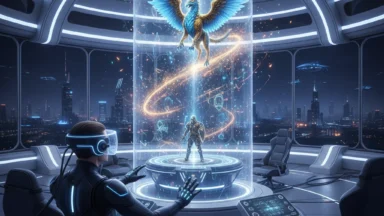
In the rapidly evolving landscape of video games, the quest for ever-larger, more immersive, and endlessly replayable worlds has driven innovation to new heights. Manual creation of such vast environments is often impractical, if not impossible, leading developers to embrace the power of procedural generation. This isn’t just about randomly scattering assets; it’s about employing sophisticated procedural generation algorithms to craft intricate, believable, and dynamic virtual spaces.
Welcome to Procedural Generation 3.0, where the focus shifts from mere randomness to intelligent, context-aware, and artist-driven generation. This article delves into eight advanced procedural generation algorithms that are shaping the future of game development, offering unparalleled opportunities for emergent gameplay, unique player experiences, and efficient content creation. From sprawling landscapes to intricate architectural designs and dynamic quest lines, these algorithms are the unseen architects of the digital realms we explore.
The Evolution of Procedural Generation: From Basic Randomness to Intelligent Design
Before we dive into the specifics of advanced procedural generation algorithms, it’s crucial to understand how this field has matured. Early forms of procedural generation often relied on simple random number generators to place elements, leading to environments that felt chaotic and lacked cohesion. While effective for some applications, this approach quickly revealed its limitations when aiming for believable or aesthetically pleasing results.
Procedural Generation 1.0 was characterized by basic noise functions and simple rule sets, generating rudimentary terrains or dungeon layouts. Think of early roguelikes with their grid-based, somewhat repetitive maps.
Procedural Generation 2.0 introduced more sophisticated noise functions (like Perlin and Simplex), cellular automata, and L-Systems, allowing for more organic and complex shapes. Games like Minecraft brilliantly showcase the power of these techniques to create vast, varied terrains with distinct biomes.
Procedural Generation 3.0, our current frontier, integrates machine learning, advanced graph theory, constraint satisfaction, and even artistic heuristics to create content that not only looks natural but also serves specific gameplay purposes. It’s about generating ‘meaningful’ content – worlds with history, logic, and emergent narratives. This new era of procedural generation algorithms aims to bridge the gap between algorithmic efficiency and handcrafted quality.
1. Wave Function Collapse (WFC): The Art of Constrained Generation
One of the most exciting recent developments in procedural generation algorithms is Wave Function Collapse (WFC). Inspired by quantum mechanics, WFC generates patterns by observing a sample image and then propagating constraints. Instead of generating from scratch, it takes existing patterns or tiles and intelligently arranges them based on compatibility rules.
Imagine you have a set of tiles (e.g., floor, wall, corner, intersection). WFC starts with an ‘uncollapsed’ state where every tile position could potentially be any tile. It then observes a seed tile and collapses its ‘wave function’ to that specific tile. This collapse propagates constraints to neighboring cells: if a wall tile is placed, its neighbors can only be other wall tiles or specific floor tiles that connect to a wall. This process continues until all cells are collapsed into a consistent, valid pattern.
WFC excels at generating coherent structures, from buildings and dungeons to entire cities and organic textures, all while adhering to a predefined aesthetic or set of rules derived from example data. It’s a powerful tool for achieving specific styles without manual placement.
2. L-Systems (Lindenmayer Systems): The Grammar of Growth
L-Systems are a formal grammar used to model the growth processes of plants and other biological structures. They operate on a simple principle: a starting axiom (a symbol string) is iteratively replaced by production rules. For example, ‘F’ might mean ‘draw forward’, and ‘F -> FF’ means ‘replace F with FF’. A rule like ‘X -> F-[[X]+X]+F[+FX]-X’ can generate incredibly complex and organic-looking tree structures.
These procedural generation algorithms are invaluable for creating natural elements like trees, bushes, rivers, and even fractal landscapes. By adjusting the production rules, angles, and probabilities, developers can generate an infinite variety of flora and natural formations, each adhering to a biologically plausible growth pattern. The beauty of L-Systems lies in their ability to produce high complexity from very simple rules, making them highly efficient for generating vast natural environments.
3. Cellular Automata: Emergent Complexity from Simple Rules
Cellular automata (CA) are discrete models that consist of a grid of cells, each in one of a finite number of states. The state of each cell evolves over time according to a set of rules based on the states of its neighboring cells. The most famous example is Conway’s Game of Life.
In game development, CA are excellent procedural generation algorithms for creating organic-looking cave systems, dungeon layouts, or even simulating natural phenomena like fire spread or fluid dynamics. By defining simple rules (e.g., ‘a dead cell with 3 living neighbors becomes alive’, ‘a living cell with fewer than 2 living neighbors dies’), complex and often beautiful patterns emerge. This emergent behavior makes CA a fascinating tool for generating dynamic and unpredictable environments that still feel natural.
4. Voronoi Diagrams and Delaunay Triangulation: Defining Spaces and Boundaries
Voronoi diagrams partition a plane into regions based on their distance to a set of points (seeds). Each region consists of all points closer to one seed than to any other. Delaunay triangulation is the dual of the Voronoi diagram, connecting neighboring seeds to form a network of triangles.
These geometric procedural generation algorithms are incredibly versatile. Voronoi diagrams can be used to generate distinct biomes in a game world, define territories, create interesting rock formations, or even lay out city districts. Delaunay triangulation can then be used to create roads or connections between these regions, ensuring a traversable and logically connected world. They provide a robust framework for dividing space and creating clear boundaries, which is crucial for structured world generation.
5. Perlin Noise and Simplex Noise: The Foundations of Organic Worlds
No discussion of procedural generation algorithms would be complete without mentioning Perlin Noise and its more efficient successor, Simplex Noise. Developed by Ken Perlin, these gradient noise functions are fundamental to generating natural-looking textures, terrains, and patterns. They produce coherent, pseudo-random values that smoothly transition across space, avoiding the blockiness of pure random generation.
Perlin noise is used extensively to create:
- Realistic heightmaps for mountains and valleys.
- Variations in textures, like rock formations or water surfaces.
- Cloud formations and atmospheric effects.
- Biomes transitions and resource distribution.
By layering multiple octaves of noise at different frequencies and amplitudes, developers can achieve incredibly detailed and organic-looking results. Simplex noise offers similar quality with improved performance and fewer directional artifacts, making it a preferred choice for many modern applications.
6. Graph-Based Generation: Structuring Complex Relationships
Graph-based procedural generation algorithms represent game worlds not just as static geometry, but as networks of interconnected nodes and edges. Each node might represent a room, a point of interest, a quest objective, or even a character, while edges define relationships or pathways between them.
This approach is particularly powerful for generating:
- Dungeon layouts with specific connectivity requirements (e.g., ensuring all rooms are reachable).
- Quest lines with branching narratives and interdependencies.
- Social networks between NPCs, influencing their behavior and interactions.
- City layouts with road networks and district specializations.
By applying algorithms like Dijkstra’s for shortest paths or various graph traversal methods, developers can generate coherent and functional structures that support complex gameplay mechanics. Graph-based generation moves beyond mere aesthetics to create systems with inherent logic and emergent properties.
7. Space Colonization Algorithm: Growing Organic Structures with Purpose
The Space Colonization Algorithm is a fascinating method for generating tree-like structures that mimic natural growth patterns, but with a specific objective – to ‘reach out’ and colonize a given space. It starts with a set of ‘attraction points’ (e.g., nutrient sources or light sources) and a base point for the structure.
Branches then grow iteratively, extending towards the nearest attraction points. As a branch gets closer to an attraction point, that point might be ‘consumed’ or become less attractive, forcing the branch to seek new directions. This results in highly organic, efficient, and visually appealing branching structures. It’s an excellent procedural generation algorithm for creating realistic trees, root systems, lightning bolts, or even abstract organic art. Unlike L-Systems which are purely rule-based, space colonization is goal-oriented, leading to structures that appear to have grown with a purpose.
8. Machine Learning and AI-Assisted Generation: The Future Frontier
Perhaps the most revolutionary aspect of Procedural Generation 3.0 is the integration of machine learning (ML) and artificial intelligence (AI). These advanced procedural generation algorithms are moving beyond explicit rules to learn patterns and generate content adaptively.
Examples include:
- Generative Adversarial Networks (GANs): GANs can learn from existing game assets (e.g., textures, character models, level layouts) and generate new, similar content that is often indistinguishable from human-made assets.
- Reinforcement Learning: AI agents can be trained to design levels that are challenging, fair, and fun, based on player feedback or simulated playtesting.
- Neural Networks for Style Transfer: Applying the artistic style of one image to procedurally generated content, allowing for consistent aesthetics across vast, generated worlds.
- AI for Narrative Generation: Creating dynamic quest lines, character dialogues, and lore that adapt to player choices and emergent events.
ML and AI-assisted generation promise to unlock unprecedented levels of detail, variety, and intelligence in procedurally generated content, blurring the lines between algorithmic creation and artistic design. They enable systems to ‘understand’ what makes good content and generate it autonomously.

Implementing Procedural Generation Algorithms: Challenges and Best Practices
While the potential of these procedural generation algorithms is immense, their implementation comes with its own set of challenges. It’s not just about writing code; it’s about blending technical prowess with artistic vision and game design principles.
Balancing Control and Randomness
A common pitfall is allowing algorithms too much freedom, leading to incoherent or unplayable content. The key is to provide enough constraints and parameters to guide the generation process, ensuring that the output aligns with the game’s vision. This often means carefully curating seed values, rule sets, and input data.
Performance Considerations
Generating vast worlds in real-time can be computationally intensive. Developers must optimize their procedural generation algorithms for efficiency, often employing techniques like:
- Chunking: Generating and loading parts of the world as the player approaches them.
- Level of Detail (LOD): Creating simplified versions of distant objects.
- Multithreading: Distributing generation tasks across multiple CPU cores.
- Caching: Storing generated data to avoid regeneration.
Ensuring Quality and Playability
Procedural generation can sometimes produce unexpected or undesirable results. Robust testing, both automated and manual, is crucial to identify and mitigate these issues. Integrating metrics for ‘fun’ or ‘playability’ into the generation process can help algorithms self-correct and produce better content. For instance, a dungeon generation algorithm might be tweaked to ensure a minimum number of encounters or a maximum distance between key objectives.
Artistic Direction and Iteration
Procedural generation is not a ‘set it and forget it’ solution. It requires continuous iteration and fine-tuning. Artists and designers play a critical role in providing input, defining desired aesthetics, and refining the parameters that guide the algorithms. The best procedurally generated worlds are a collaboration between human creativity and algorithmic power.
The Impact on Game Design and Player Experience
The widespread adoption of advanced procedural generation algorithms has profound implications for both game design and the player experience.
Infinite Replayability
For players, procedural generation offers the promise of endless discovery. Games like No Man’s Sky, Terraria, and Factorio provide unique experiences with every playthrough, as worlds, challenges, and opportunities are never exactly the same. This significantly extends a game’s lifespan and value.
Reduced Development Costs and Time
For developers, these algorithms can dramatically reduce the manual effort required to create vast amounts of content. Instead of meticulously crafting every rock and tree, designers can focus on defining the rules and aesthetics, letting the algorithms do the heavy lifting. This frees up resources for other aspects of game development, such as core mechanics, storytelling, and optimization.
Emergent Gameplay and Narrative
When worlds are generated dynamically, unexpected situations and unique challenges naturally arise. This leads to emergent gameplay, where players create their own stories and strategies in response to the generated environment. A procedurally generated dungeon might present a unique combination of enemies and traps that forces a player to adapt their usual tactics, leading to memorable moments.
Facilitating Modding and User-Generated Content
Procedural systems can also empower modders and players to create their own content more easily. By providing tools that leverage these algorithms, communities can generate new levels, items, or even entire game modes with relative ease, further extending a game’s longevity.
Conclusion: The Infinite Possibilities of Procedural Generation 3.0
The journey from basic random number generators to sophisticated procedural generation algorithms like Wave Function Collapse and AI-assisted creation is a testament to the innovation driving the game industry. These algorithms are not just tools for creating content; they are catalysts for new forms of game design, enabling experiences that are vast, dynamic, and deeply personal.
As technology continues to advance, we can expect even more intelligent and adaptive procedural systems. The future of game worlds is not just about size, but about depth, coherence, and the ability to surprise and delight players with endless, unique adventures. By mastering these advanced procedural generation algorithms, developers are unlocking the true potential of infinite digital realms, ensuring that the magic of discovery never truly ends.
Embrace the algorithms, and prepare to explore worlds beyond imagination!