Unity vs Godot 2026: The Future of Game Engine Development
The landscape of game development is ever-evolving, with new technologies and methodologies constantly shaping how games are made. As we forge ahead into 2026, two names continue to dominate discussions among developers: Unity and Godot. These game engines, each with its unique philosophy and strengths, have undergone significant transformations, pushing the boundaries of what’s possible in interactive entertainment. This article provides an in-depth Unity Godot 2026 comparison, exploring their latest features, performance, community support, and suitability for various projects, from indie gems to AAA blockbusters.

How would you like to receive it?
Select the option that suits you best.
The Evolution of Game Engines: A 2026 Perspective
To truly understand the current standing of Unity and Godot, it’s crucial to look back at their journey and anticipate their trajectory. Both engines have consistently adapted to industry demands, integrating cutting-edge rendering techniques, optimizing workflows, and expanding their feature sets. In 2026, the focus has shifted even further towards accessibility, performance at scale, and the integration of AI-driven tools.
Unity’s Continued Dominance and Innovation
Unity, a veteran in the game development scene, has long been a go-to choice for a vast spectrum of creators. Its strength lies in its comprehensive toolset, extensive asset store, and robust community. By 2026, Unity has doubled down on its Data-Oriented Technology Stack (DOTS), making it more mature and accessible for developers aiming for high-performance, complex simulations and large-scale worlds. The Universal Render Pipeline (URP) and High Definition Render Pipeline (HDRP) have seen significant enhancements, offering unparalleled visual fidelity and flexibility across different platforms, from mobile to console to PC and even emerging mixed reality devices.
The scripting experience in Unity, primarily C#, has also been refined. Integrated development environments (IDEs) offer more intelligent code completion and debugging tools, streamlining the development process. Furthermore, Unity’s cloud services have expanded, providing more seamless collaboration, automated build pipelines, and advanced analytics for live games. The Unity Godot 2026 comparison often highlights Unity’s enterprise-level solutions and its strong foothold in industries beyond gaming, such as automotive, architecture, and film, which further fuels its development and resource allocation.
Godot’s Ascendance as an Open-Source Powerhouse
Godot, on the other hand, has steadily gained traction, particularly within the indie development community and among those who champion open-source software. Its commitment to a community-driven development model and its permissive MIT license have fostered a loyal and rapidly growing user base. By 2026, Godot has significantly matured, moving beyond its initial reputation as purely a 2D engine to become a formidable contender in 3D game development.
Godot’s custom scripting language, GDScript, remains a beloved feature for its simplicity and ease of use, often cited as being more intuitive for beginners than C#. However, its C# support has also been vastly improved, offering more options for experienced developers. The engine’s rendering capabilities have seen substantial upgrades, with Vulkan-based rendering becoming standard, enabling stunning visuals and optimized performance. The modular architecture of Godot allows for greater customization and control, empowering developers to tailor the engine precisely to their project’s needs without being constrained by proprietary systems. This flexibility is a key differentiator in any Unity Godot 2026 analysis.
Core Features: A Deep Dive into Unity and Godot in 2026
Rendering and Graphics
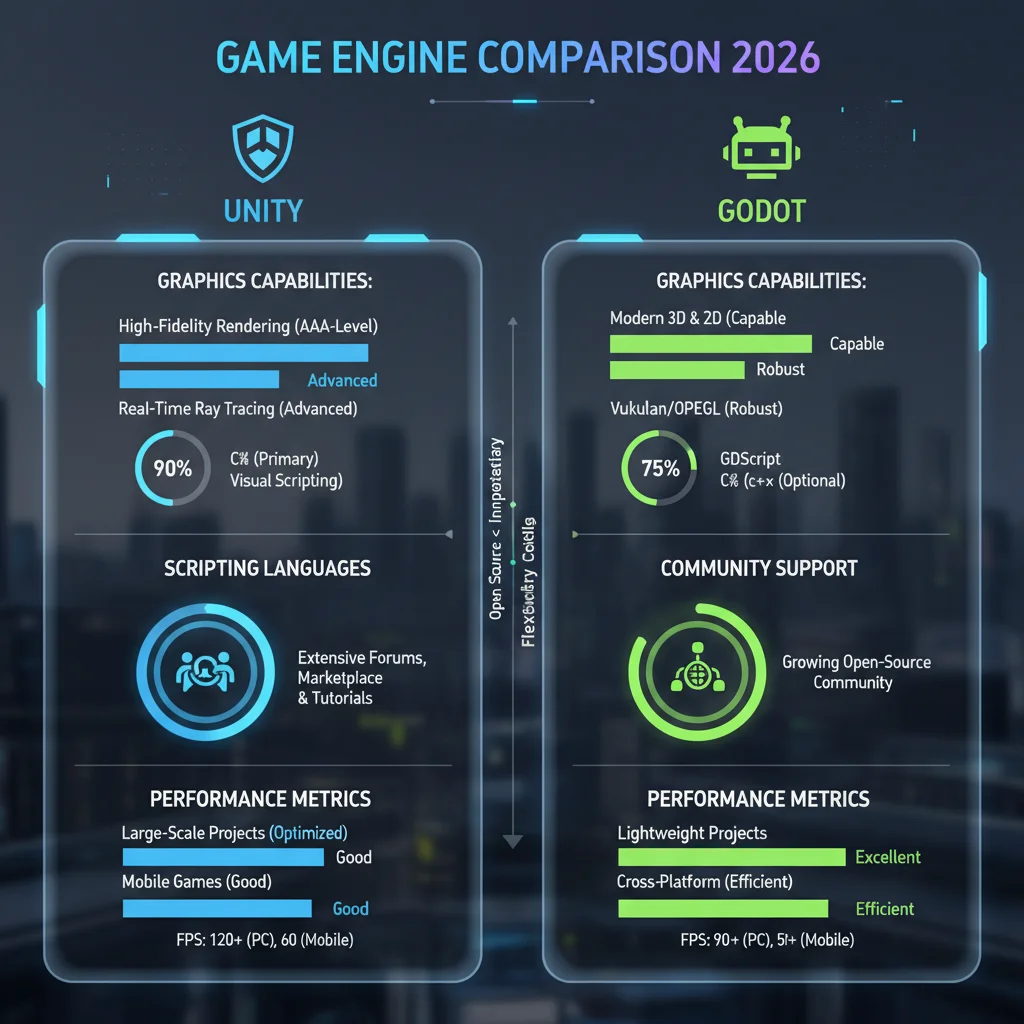
In 2026, both Unity and Godot offer state-of-the-art rendering pipelines. Unity’s URP and HDRP provide scalable solutions for diverse visual targets. HDRP, in particular, delivers photorealistic graphics with advanced lighting, global illumination, and post-processing effects, making it suitable for high-end cinematic experiences. URP, while optimized for performance across a wider range of devices, still offers impressive visuals and a highly customizable rendering path.
Godot’s rendering engine, powered by Vulkan, has made remarkable strides. It now supports advanced features like real-time global illumination (GI), physically based rendering (PBR), and sophisticated shader development, rivaling the visual output of more established engines. The ease with which developers can create custom shaders in Godot is a significant advantage for those seeking unique artistic styles. The move to a more efficient rendering architecture has significantly boosted Godot’s performance on modern hardware, closing the gap with Unity in terms of visual fidelity and speed.
Scripting and Programming
Scripting is the heart of game logic, and both engines offer powerful options. Unity’s C# environment is robust, benefiting from decades of refinement and a massive ecosystem of libraries and tools. Its integration with Visual Studio and other IDEs provides a powerful and familiar experience for professional programmers. The DOTS framework, with its Entity Component System (ECS) and Job System, has transformed how high-performance code is written in Unity, allowing for highly optimized simulations and game logic that can fully leverage multi-core processors. This is a significant factor when considering complex gameplay mechanics in Unity Godot 2026 projects.
Godot’s GDScript remains a cornerstone of its appeal. Its Python-like syntax makes it incredibly approachable for beginners, enabling rapid prototyping and iterative development. For those needing more power, Godot’s C# support has matured, offering comparable performance to Unity’s C# for many tasks. Additionally, Godot’s C++ module system allows for direct engine extension, providing unparalleled control and optimization opportunities for expert developers. This flexibility in scripting languages caters to a broader range of developer skill sets and preferences.
Asset Management and Workflow
Unity’s Asset Store is a colossal marketplace, offering millions of ready-to-use assets, tools, and plugins. This vast library significantly accelerates development, especially for smaller teams or solo developers who might lack the resources to create everything from scratch. Unity’s editor workflow is highly integrated, allowing for intuitive scene building, animation, and UI design. The package manager system has also improved, making it easier to manage dependencies and integrate third-party tools.
Godot, while not having a marketplace on the scale of Unity’s, boasts a growing asset library and a strong community that shares resources freely. Its scene-based architecture, where everything is a node and scenes can be nested, provides a highly organized and flexible workflow. Godot’s editor is lightweight and runs natively on various platforms, offering a consistent experience. The engine’s focus on a minimal footprint and fast iteration times makes it very appealing for developers who prioritize efficiency and a streamlined workflow. When comparing Unity Godot 2026, the asset ecosystem often becomes a significant point of consideration for many.
Community, Support, and Learning Resources
Unity’s Extensive Ecosystem
Unity benefits from a massive, established community. There are countless tutorials, courses, forums, and official documentation available, making it relatively easy for new developers to get started and for experienced developers to find solutions to complex problems. Unity’s official support channels, certifications, and educational programs further solidify its position as a well-supported engine. The sheer volume of developers using Unity also means a larger talent pool for studios looking to hire.
Godot’s Growing and Passionate Community
Godot’s community is smaller but incredibly passionate and active. Its open-source nature fosters a collaborative environment where developers contribute to the engine’s core, create documentation, and share knowledge generously. The official Godot documentation is highly regarded for its clarity and comprehensiveness. While the number of tutorials might not match Unity’s, the quality is often exceptional, and the community is very responsive on platforms like Reddit, Discord, and various forums. The rapid growth of Godot’s user base in the past few years indicates a strong future for its community and support infrastructure, making it a viable alternative in the Unity Godot 2026 landscape.
Performance and Optimization in 2026
Performance is paramount in game development, and both engines have made significant strides. Unity’s DOTS, when fully utilized, allows for incredible performance gains, especially in scenarios involving many entities or complex physics simulations. Its highly optimized render pipelines ensure efficient use of GPU resources. However, achieving peak performance in Unity often requires a deeper understanding of its underlying architecture and optimization techniques.
Godot’s 2026 iteration boasts a highly optimized rendering backend and improved physics engine. Its lightweight nature and efficient design often translate to excellent performance out of the box, especially for 2D games and less graphically intensive 3D titles. The engine’s modularity also allows developers to strip away unnecessary features, further optimizing for specific platforms and performance targets. While Unity might offer higher theoretical peak performance for extremely complex AAA titles with DOTS, Godot often provides a more straightforward path to good performance for a broader range of projects.
Target Platforms and Export Capabilities
Both Unity and Godot offer extensive multi-platform support. Unity has long been a leader in this regard, allowing developers to target virtually every major platform, including PC (Windows, macOS, Linux), consoles (PlayStation, Xbox, Nintendo Switch), mobile (iOS, Android), web (WebGL), and various XR devices. Its build pipeline is robust and highly configurable.
Godot’s export capabilities have also matured significantly. It supports PC, mobile, web, and various console platforms through third-party porting services. While its console support might not be as natively integrated as Unity’s, the options are readily available and continuously improving. The open-source nature of Godot also means that community contributions often lead to experimental or niche platform support that might not be prioritized by commercial engines. This broad platform reach is critical for any developer considering Unity Godot 2026 for their next project.
Monetization and Business Models
Unity’s business model has seen various iterations, but in 2026, it primarily revolves around subscription tiers (Personal, Plus, Pro, Enterprise) and various services like monetization tools, analytics, and cloud builds. The revenue share model has been a point of discussion, but Unity continues to offer a comprehensive suite of tools for developers to monetize their games through ads, in-app purchases, and other strategies.
Godot, being open-source, operates on a completely different model. The engine itself is free to use, with no licensing fees or royalties. Its development is supported by donations from individuals and companies. This ‘no strings attached’ approach is a huge draw for many developers, especially indies, as it means they retain 100% of their game’s revenue. While Godot doesn’t offer built-in monetization services, it provides the flexibility to integrate any third-party solution, giving developers complete control over their business model. This fundamental difference is often a deciding factor in a Unity Godot 2026 choice.
Use Cases: Who Should Use Which Engine in 2026?
Why Choose Unity in 2026?
- Large-scale AAA Productions: With its advanced rendering pipelines (HDRP), robust DOTS framework, and extensive toolset, Unity is well-equipped for developing graphically intensive, complex AAA titles.
- Enterprise Solutions: For industries outside of gaming that require real-time 3D visualization, simulation, and interactive experiences, Unity’s established ecosystem and professional support are invaluable.
- Mobile Games with High Fidelity: Unity’s URP and comprehensive mobile development tools make it an excellent choice for creating high-quality mobile games with optimized performance.
- Augmented and Virtual Reality: Unity has a strong track record and continuous investment in XR development, offering excellent tools and integrations for AR/VR projects.
- Teams needing extensive asset libraries: Access to the Unity Asset Store can significantly speed up development for teams that can leverage pre-made assets and tools.
Why Choose Godot in 2026?
- Indie Developers and Small Teams: Godot’s ease of use, rapid prototyping capabilities, and zero-cost model make it ideal for independent creators and small studios.
- 2D Games: Godot continues to excel in 2D game development, offering a highly intuitive and powerful set of tools specifically designed for 2D workflows.
- Open-Source Enthusiasts: For developers who value transparency, community contribution, and full control over their tools, Godot is the natural choice.
- Learning and Education: Its friendly learning curve and clear documentation make Godot an excellent engine for aspiring game developers and educational institutions.
- Projects with specific customization needs: Godot’s modular architecture and C++ extension capabilities allow for deep customization of the engine itself, which is crucial for niche projects.
The Future Ahead: Beyond 2026
Looking beyond 2026, both Unity and Godot are poised for continued growth and innovation. Unity will likely further integrate AI into its development pipeline, offering AI-assisted content generation, asset optimization, and even AI-powered gameplay mechanics. Its focus on cloud-based collaboration and services will also intensify, catering to the needs of distributed development teams.
Godot’s future will undoubtedly be shaped by its community. Expect to see continued improvements in its 3D rendering, physics, and tooling, driven by the collective efforts of its passionate user base. As more developers adopt Godot, its ecosystem will grow, leading to more assets, tutorials, and third-party integrations. The open-source nature ensures that Godot will remain adaptable and responsive to emerging technologies and developer needs.
The competition between these two engines is not just about market share; it’s a driving force for innovation across the entire game development industry. As Unity Godot 2026 continues to push boundaries, developers benefit from more powerful, accessible, and versatile tools to bring their creative visions to life.
Conclusion
In conclusion, both Unity and Godot stand as incredibly powerful and capable game engines in 2026, each with its distinct advantages. Unity offers a comprehensive, industry-standard solution with vast resources, best suited for large-scale projects, professional studios, and those heavily invested in the broader interactive media space. Godot provides an agile, open-source alternative with a strong emphasis on community, flexibility, and developer freedom, making it an excellent choice for indie creators, 2D games, and those who prefer a less constrained development environment.
The choice between Unity Godot 2026 ultimately depends on your project’s specific requirements, your team’s expertise, your budget, and your philosophical alignment with their respective development models. Regardless of your choice, the future of game development is bright, with these two engines leading the charge into exciting new frontiers of creativity and technological advancement.