The landscape of video games is in a constant state of evolution, with cloud gaming emerging as a transformative force. What once seemed like a distant dream is rapidly becoming a mainstream reality, challenging traditional notions of hardware ownership and game accessibility. However, the Achilles’ heel of cloud gaming has always been latency – the imperceptible yet critical delay between a player’s input and the game’s response. For years, this challenge has hindered cloud gaming from truly replicating the responsiveness of local play, especially for competitive titles. But imagine a world where this delay is virtually eliminated, where the difference between playing on a high-end local PC and streaming a game from a remote server is indistinguishable. This is the promise of a 15ms latency reduction in cloud gaming, a milestone projected to profoundly impact US players by 2026.
This article will delve deep into the implications of this significant technological leap. We will explore what a 15ms reduction in cloud gaming latency truly means for the average gamer, the competitive esports scene, and the broader industry. We’ll examine the underlying technologies driving this improvement, the challenges that remain, and the exciting future that awaits US players as cloud gaming sheds its last major technical constraint. Get ready to witness a paradigm shift in how we play, consume, and experience video games.
The Current State of Cloud Gaming Latency: A Baseline for Comparison
Before we can appreciate the magnitude of a 15ms reduction, it’s crucial to understand where cloud gaming latency stands today. Currently, average cloud gaming latency for US players can range anywhere from 30ms to over 100ms, depending on various factors such as geographic distance to the server, internet service provider (ISP) quality, home network setup, and the specific cloud gaming platform. This figure encompasses several components:
- Input Latency: The time it takes for your controller or keyboard input to register on the server.
- Processing Latency: The time the server takes to process your input and render the next frame.
- Network Latency (Ping): The round-trip time for data to travel from your device to the server and back. This is often the largest component.
- Encoding/Decoding Latency: The time taken for the server to encode the video stream and for your device to decode it.
- Display Latency: The time your monitor or TV takes to display the received frame.
While platforms have made significant strides, even a 50ms total latency can be noticeable, especially in fast-paced genres like first-person shooters (FPS) or fighting games. This noticeable delay, often perceived as ‘lag,’ can lead to missed shots, unresponsive controls, and a general feeling of disconnect from the game world, deterring many serious gamers from fully embracing cloud solutions. The goal has always been to bring this total latency down to levels comparable to local play, typically considered to be below 30-40ms, where most human perception struggles to detect the delay. A 15ms reduction from the current averages would bring many players well within this optimal range, fundamentally altering the cloud gaming experience.
Defining ’15ms Reduction’: What Does it Mean in Real Terms?
A 15ms reduction in cloud gaming latency isn’t just a number; it represents a tangible improvement in responsiveness and fluidity. To put it into perspective:
- Human Perception: The average human reaction time is around 200-250ms. While 15ms might seem small in isolation, it’s a significant chunk when considering the entire latency chain. Professional esports players can detect differences as low as 5-10ms.
- Impact on Gameplay: In a game where every millisecond counts, a 15ms improvement can mean the difference between a headshot and a miss, a perfectly timed dodge and a fatal blow. It makes controls feel tighter, movements more precise, and the overall interaction with the game world far more immediate.
- Competitive Edge: For esports, this reduction closes the gap between cloud players and those on local hardware, potentially leveling the playing field and making cloud platforms viable for serious competitive play.
- Immersion: Beyond competitive advantages, lower latency enhances immersion. When there’s no perceptible delay between your actions and the game’s response, the virtual world feels more real and connected, drawing you deeper into the experience.
This isn’t about minor tweaks; it’s about addressing a core technical limitation that has held cloud gaming back. Achieving this level of reduction requires advancements across multiple technological fronts, from network infrastructure to server-side processing and client-side rendering.
Technological Pillars Driving the Cloud Gaming Latency Reduction
Achieving a 15ms reduction in cloud gaming latency by 2026 is an ambitious goal, but it’s one that leading technology companies and cloud providers are actively pursuing through a combination of synergistic innovations. Several key technological pillars are converging to make this a reality:
1. Edge Computing and Distributed Data Centers
The concept of edge computing is paramount to reducing network latency. Instead of relying on centralized data centers that might be hundreds or thousands of miles away from a player, edge computing brings computational resources closer to the user. This means deploying smaller, regional data centers or even micro-servers at the very ‘edge’ of the network, such as within local ISP facilities or 5G base stations. By minimizing the physical distance data has to travel, the round-trip time (ping) is drastically cut. For US players, this means more localized servers, ensuring that even if you’re in a less populated area, there’s a cloud gaming node relatively nearby.
2. 5G Network Expansion and Optimization
The rollout and continued optimization of 5G networks are critical. 5G offers significantly lower latency compared to previous cellular generations, often boasting single-digit millisecond latency (under ideal conditions). This low-latency wireless backbone is essential for mobile cloud gaming and for providing high-quality connections in areas where fiber optic broadband isn’t readily available. Furthermore, network slicing, a 5G capability, allows for dedicated network resources with guaranteed latency and bandwidth for specific applications like cloud gaming, ensuring a premium experience even during peak network usage.
3. Advanced Video Encoding and Decoding
Streaming high-fidelity video in real-time requires efficient encoding and decoding. New codecs like AV1, along with hardware-accelerated encoding/decoding, are continuously reducing the processing time required to compress and decompress video streams. This directly impacts ‘encoding/decoding latency.’ As these technologies mature and become more widely adopted in both server hardware and client devices, they contribute significantly to overall latency reduction without sacrificing visual quality.
4. Predictive Algorithms and AI
Artificial intelligence and machine learning are playing an increasingly vital role. Predictive algorithms can analyze player input patterns and network conditions to anticipate actions. For instance, if a player is moving forward, the system might pre-render a few frames ahead in that direction. While this doesn’t reduce raw network latency, it can mask its effects, making the game feel more responsive. AI can also be used for dynamic bitrate adjustment and resolution scaling, ensuring a smooth experience even with fluctuating network conditions, thereby preventing sudden spikes in perceived latency.
5. Optimized Game Engines and Server-Side Rendering
Game developers and cloud gaming platforms are working together to optimize game engines for cloud environments. This includes techniques like server-side frame generation optimization, where the game server is specifically tuned to render frames as quickly as possible. Furthermore, technologies like ‘frame pacing’ and ‘input buffering’ are being refined to synchronize client input with server output more effectively, minimizing perceived lag. Dedicated cloud gaming hardware, custom-built for streaming, also contributes to faster processing and lower latency.
Impact on US Players: A Revolution in Gaming by 2026
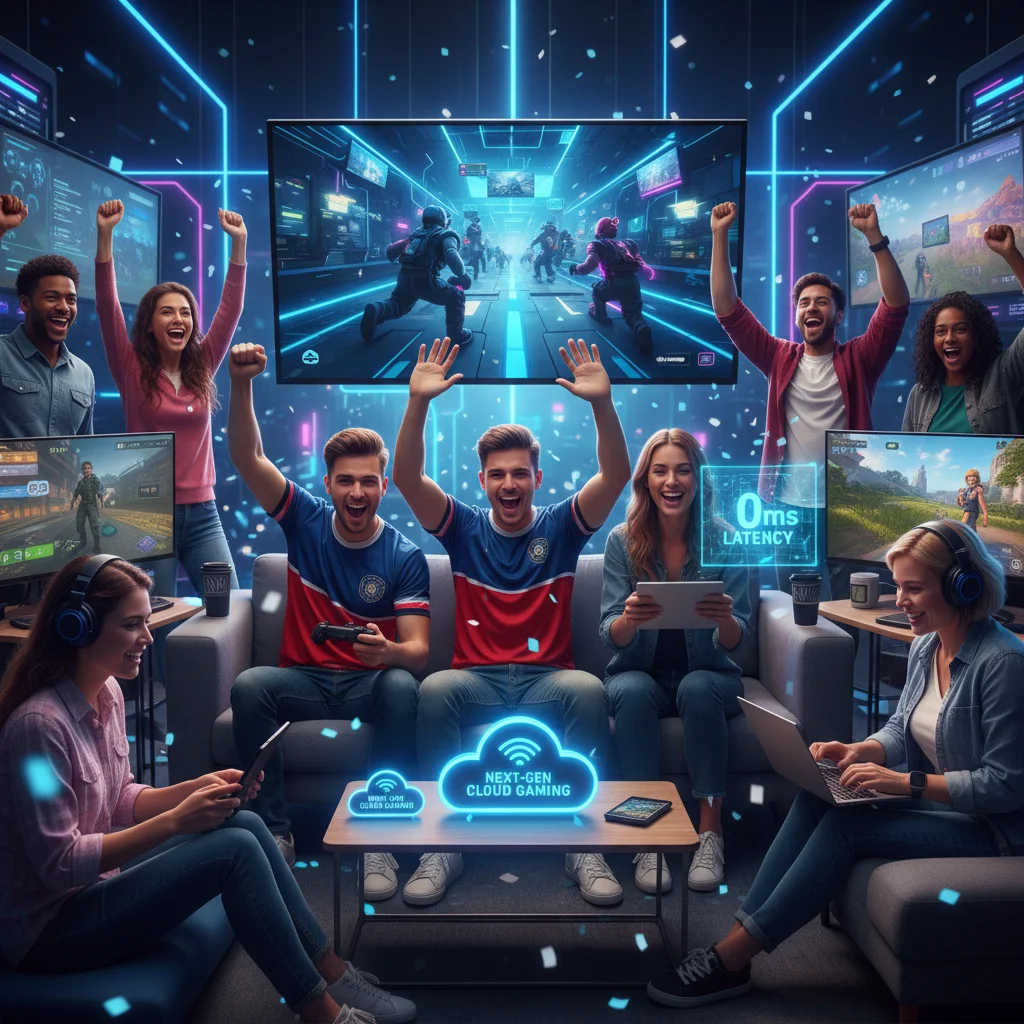
The cumulative effect of these technological advancements, culminating in a 15ms reduction in cloud gaming latency, will usher in a new era for US players across all segments of the gaming community.
Enhanced Accessibility and Inclusivity
With latency becoming less of a barrier, cloud gaming will become a truly viable option for millions more. Players without access to high-end gaming PCs or consoles, or those who prefer the convenience of playing on any screen, will experience games with a responsiveness previously reserved for dedicated hardware. This democratizes gaming, making the latest titles accessible to a wider audience, regardless of their budget for hardware. It also fosters inclusivity, allowing more people to participate in the gaming culture.
Transforming Competitive Gaming and Esports
Perhaps nowhere will the impact be more keenly felt than in competitive gaming and esports. Historically, professional players have shunned cloud gaming due to its inherent latency disadvantage. A 15ms reduction, bringing total latency down to near-local levels, could change this entirely. Esports organizations might begin to consider cloud platforms for training, qualifiers, and even mainstream tournaments. This opens up new possibilities for distributed esports events, reducing travel costs and expanding the talent pool. The competitive landscape will be redefined, with skill and strategy taking absolute precedence over hardware advantages.
Unlocking New Game Genres and Experiences
Certain game genres are particularly sensitive to latency. Fighting games, rhythm games, and precise platformers demand instantaneous feedback. With significantly reduced cloud gaming latency, these genres will become perfectly playable and enjoyable on cloud platforms, expanding the library of ‘cloud-friendly’ games. Furthermore, game developers will be freed to innovate with new mechanics that rely on ultra-low latency, potentially leading to entirely new types of interactive experiences that are currently impractical.
Ubiquitous Gaming Across Devices
The vision of gaming anywhere, on any screen, becomes a seamless reality. Whether on a smart TV, a tablet, a smartphone, or a low-spec laptop, the core gaming experience will be consistent and responsive. This means players can effortlessly switch between devices, continuing their game without interruption or compromise in quality due to lag. This ‘Netflix of games’ model becomes truly compelling when the technical hurdles of latency are overcome, offering unparalleled convenience.
Economic Impact and Market Growth
The improved player experience will undoubtedly fuel further growth in the cloud gaming market. More players will subscribe, leading to increased revenue for platform providers and game developers. This economic boost can in turn fund more innovation, creating a positive feedback loop. Hardware manufacturers might shift focus, and ISPs will see increased demand for high-speed, low-latency internet connections, potentially driving infrastructure investments.
Challenges and Remaining Hurdles
While the path to a 15ms latency reduction is clear, it’s not without its challenges. Several factors still need to be addressed to ensure a consistent and high-quality experience for all US players:
- Last-Mile Connectivity: Even with advanced infrastructure, the ‘last mile’ – the connection from the local network node to the player’s home – remains crucial. Variances in home Wi-Fi quality, older modem/router technology, and local network congestion can still introduce latency.
- Geographic Disparities: While edge computing helps, players in extremely rural or remote areas of the US might still face higher latencies due to sheer distance from the nearest data center. Universal high-speed, low-latency internet access remains a long-term goal.
- Cost of Infrastructure: Deploying and maintaining the extensive network of edge servers and 5G infrastructure required for ultra-low latency cloud gaming is a massive capital investment. These costs will need to be recouped, potentially influencing subscription prices.
- Power Consumption: Running countless distributed servers and high-performance networking equipment consumes significant energy. Sustainable solutions and energy-efficient hardware will be critical for long-term viability.
- Software Optimization: While hardware and network improvements are key, continuous software optimization at every layer – from the operating system to the game engine – is essential to squeeze out every millisecond of performance.
These challenges are being actively tackled by industry leaders, and while they present significant hurdles, the momentum towards achieving ultra-low cloud gaming latency is strong.
The Future Beyond 2026: What’s Next for Cloud Gaming?
Achieving a 15ms latency reduction by 2026 is a significant milestone, but it’s by no means the end of the journey for cloud gaming. This breakthrough will serve as a springboard for even more ambitious innovations:
Hyper-Realistic Graphics and Ray Tracing
With latency largely solved, cloud platforms can focus even more resources on pushing graphical fidelity. Imagine games rendered with full path tracing and photorealistic graphics, streamed seamlessly to any device, without the need for a local supercomputer. The server-side rendering power will be virtually limitless, allowing for visual experiences far beyond what consumer hardware can currently achieve.
Truly Interactive Worlds and Massive Multiplayer Experiences
Lower latency enables more complex and responsive interactions within game worlds. This could lead to massively multiplayer online games (MMOs) with unprecedented player counts and dynamic, physics-driven environments where every player’s action has immediate and tangible consequences. The server can handle more real-time calculations, fostering more emergent gameplay.
Integration with Augmented Reality (AR) and Virtual Reality (VR)
AR and VR are incredibly latency-sensitive. Even minor delays can cause motion sickness and break immersion. As cloud gaming latency approaches imperceptible levels, it opens the door for cloud-powered AR/VR experiences, offloading heavy processing from local headsets to remote servers. This could lead to lighter, more comfortable, and more graphically impressive AR/VR worlds.
New Monetization Models and Game Development Paradigms
The shift to cloud gaming could also influence how games are developed and monetized. Subscription models will likely become even more prevalent. Developers might design games specifically for the cloud, leveraging its distributed computing power in ways that are impossible on local machines. This could foster a new wave of creativity and innovation in game design.
Conclusion: The Dawn of a Seamless Gaming Era
The journey towards a 15ms reduction in cloud gaming latency for US players by 2026 is more than just a technical achievement; it’s a fundamental shift in the gaming paradigm. It signifies the maturation of cloud gaming from a promising but flawed concept to a truly viable, high-performance alternative to traditional gaming. For the average gamer, it means unparalleled accessibility, convenience, and a responsive experience that rivals local play.
For competitive players and the esports industry, it levels the playing field, fostering new opportunities and expanding the reach of professional gaming. The technological convergence of edge computing, 5G, advanced codecs, and AI is creating a future where the constraints of hardware ownership fade into the background, allowing the pure joy of gaming to take center stage.
As we approach 2026, the promise of ultra-low cloud gaming latency is not just a dream; it’s a rapidly approaching reality that will redefine what it means to be a gamer in the United States and beyond. Get ready to experience games with an immediacy and immersion you’ve only dreamed of, as cloud gaming finally delivers on its long-held promise.