The gaming industry, a landscape of constant innovation and evolving player expectations, stands at the precipice of its next major transformation. This shift is not driven by new hardware or graphical fidelity alone, but by the burgeoning power of artificial intelligence. As we look towards 2026, the US market, a global leader in game development and consumption, is set to witness an unprecedented integration of AI into every facet of game creation and player interaction. The AI game development revolution is not a distant dream; it’s happening now, reshaping how games are conceived, built, played, and experienced.
For years, AI in gaming primarily referred to non-player character (NPC) behaviors, pathfinding algorithms, and basic decision-making trees. While these elements were foundational, they merely scratched the surface of AI’s potential. Today, advanced machine learning, deep learning, and generative AI are unlocking capabilities that were once confined to science fiction. From automating mundane development tasks to crafting infinitely replayable content and hyper-personalized narratives, AI is becoming an indispensable tool for developers and a game-changer for players.
This article delves deep into the three key trends in AI game development that are projected to have the most significant impact on the US market by 2026. We will explore how generative AI is empowering creators, how adaptive AI is redefining player engagement, and how intelligent automation is streamlining the often-complex development pipeline. Understanding these trends is crucial not only for game developers striving to stay competitive but also for investors, enthusiasts, and anyone interested in the future of interactive entertainment.
The Dawn of Generative AI: Revolutionizing Content Creation
One of the most exciting and transformative trends in AI game development is the rise of generative AI. This technology, capable of creating novel content rather than merely processing existing data, is fundamentally altering the traditional workflow of game design. By 2026, generative AI tools will be integral to the US gaming industry, moving beyond experimental phases to become mainstream powerhouses for asset creation, level design, and even narrative generation.
Procedural Content Generation on Steroids
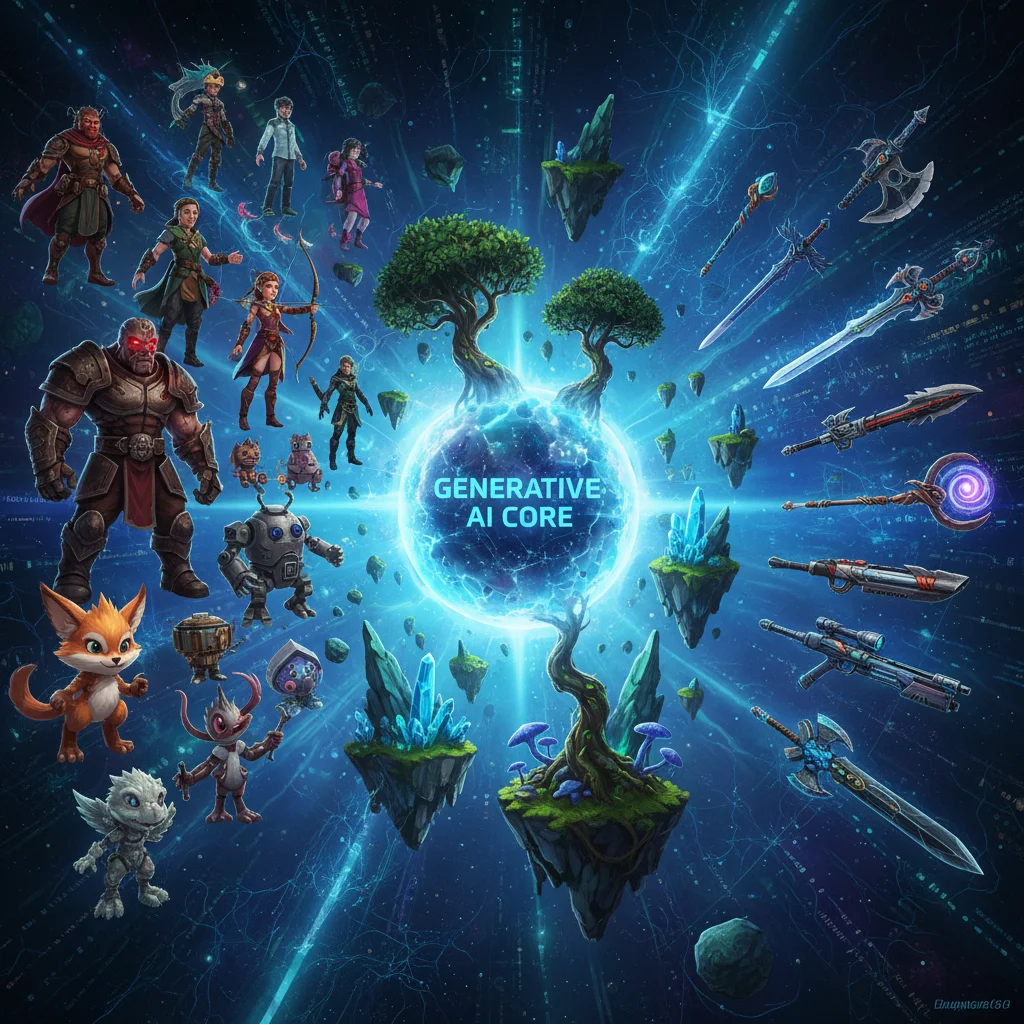
Procedural content generation (PCG) has been a part of game development for decades, used to create vast open worlds or endless dungeons. However, traditional PCG often relied on predefined rules and algorithms, leading to a certain degree of predictability or sameness. Generative AI elevates PCG to an entirely new level. Instead of following explicit rules, AI models can learn from vast datasets of existing game content – textures, models, sound effects, music, and even level layouts – to generate new, unique, and high-quality assets that adhere to specific artistic styles and design principles.
Imagine a game where every tree is unique, every rock formation distinct, and every NPC has a subtly different facial feature, all generated on the fly or during development by AI. This not only dramatically reduces the manual labor involved in creating assets but also fosters a level of environmental and character diversity previously unattainable. For indie studios, this means access to high-quality assets without massive art teams. For AAA studios, it frees up artists to focus on truly bespoke and impactful elements, pushing creative boundaries rather than repetitive tasks.
Accelerating Asset Creation and Reducing Development Costs
The cost and time associated with creating high-fidelity 3D models, intricate textures, and realistic animations are immense. Generative AI offers a compelling solution to these bottlenecks. Tools powered by AI can rapidly prototype environments, suggest character designs, or even generate entire musical scores tailored to specific in-game situations. This acceleration in asset creation directly translates to reduced development costs and shorter production cycles, allowing studios to bring more ambitious and polished games to market faster.
Consider the laborious process of creating hundreds of variations of armor, weapons, or clothing for an RPG. A generative AI system could take a few base designs and, guided by developer input, create thousands of unique permutations, each with distinct visual characteristics and statistical properties. This efficiency is a game-changer, particularly for studios operating in the highly competitive US market where speed to market and content richness are critical differentiators.
AI-Driven Narrative and Quest Generation
Beyond visual and auditory assets, generative AI is beginning to impact narrative design. While fully autonomous, compelling storytelling remains a complex challenge, AI can already assist in generating quest objectives, dialogue snippets, and even entire branching narrative paths based on player choices and game state. This opens the door to truly dynamic and emergent storytelling, where the game world reacts to the player in ways that feel organic and unpredictable.
For example, an AI could analyze player behavior and preferences to generate side quests that align with their playstyle – a stealth-focused player might receive quests involving infiltration, while a combat-oriented player might be directed towards more direct confrontations. This level of personalized storytelling, driven by AI game development, promises to enhance replayability and deepen player immersion, creating experiences that feel uniquely tailored to each individual.
Adaptive AI: Crafting Hyper-Personalized Player Experiences
The second major trend in AI game development is the evolution of adaptive AI, moving beyond simple difficulty adjustments to create genuinely hyper-personalized player experiences. By 2026, games in the US market will increasingly leverage AI to understand individual player behaviors, preferences, and skill levels, dynamically adjusting various game elements to optimize engagement, challenge, and enjoyment.
Dynamic Difficulty Scaling and Player Skill Assessment
While dynamic difficulty scaling isn’t new, adaptive AI takes it to a sophisticated level. Instead of merely increasing or decreasing enemy health or damage, AI can now analyze a player’s performance in real-time, identifying their strengths, weaknesses, and learning patterns. This allows the AI to subtly adjust enemy tactics, environmental hazards, puzzle complexity, and even the pacing of encounters to maintain an optimal flow state for the player.
For a beginner, the AI might introduce new mechanics more slowly, offer more hints, or present less aggressive opponents. For an expert, it could introduce new enemy types, complex environmental challenges, or advanced tactical scenarios to keep the challenge fresh and engaging. This prevents frustration for less skilled players and boredom for highly skilled ones, ensuring a tailored experience for everyone. This sophisticated approach to difficulty is a hallmark of advanced AI game development.
Tailored Content Delivery and Procedural Adaptation
Adaptive AI can also influence the content players encounter. Based on a player’s past choices, exploration habits, and even emotional responses (potentially inferred through biometric data or gameplay patterns), the AI can dynamically generate or select content that resonates most with that individual. This could manifest as:
- Personalized Loot Drops: An AI could learn a player’s preferred weapon type or armor aesthetic and increase the likelihood of relevant items dropping.
- Adaptive World Events: Quests, encounters, or environmental changes could be triggered based on a player’s presence in certain areas, their reputation within the game world, or their current in-game goals.
- Customized NPCs: Non-player characters might react differently to the player based on their past interactions, creating a more believable and responsive world.
- Dynamic Soundtrack and Audio Cues: AI can adapt the game’s music and sound effects to match the player’s emotional state or the intensity of the current gameplay situation, enhancing immersion.
This level of bespoke content delivery moves beyond simple branching narratives, creating a truly unique journey for every player. It’s a powerful application of AI game development to deepen engagement.
Emotional AI and Player Engagement
A more advanced, though still emerging, aspect of adaptive AI is its potential to understand and respond to player emotions. While direct emotional recognition is complex, AI can infer emotional states from gameplay data – frustration from repeated failures, excitement from successful challenges, curiosity from exploration. Armed with this information, the AI can then adapt the game to manage these emotions, perhaps offering a moment of respite after a tough battle or increasing the stakes during a period of player complacency.
This emotional intelligence in AI could lead to games that feel incredibly responsive and empathetic, fostering a deeper connection between the player and the digital world. The ethical considerations around such technology are significant, but its potential for creating profoundly engaging experiences is undeniable. The US market will likely see early implementations of this in highly narrative-driven or psychological horror games.
Intelligent Automation: Streamlining the Development Pipeline
The third crucial trend in AI game development is the application of intelligent automation to streamline various stages of the development pipeline. Game creation is notoriously complex, involving numerous disciplines and iterative processes. By 2026, AI will increasingly take on repetitive, time-consuming, or data-intensive tasks, freeing up human developers to focus on creative problem-solving and innovation.
Automated Testing and Quality Assurance
Game testing is a critical yet often arduous phase. Manual testing is prone to human error and can be incredibly slow for large, complex games. AI-powered testing tools are already making significant inroads here. These tools can simulate thousands of play sessions, identify bugs, stress-test game systems, and even provide detailed reports on performance bottlenecks. AI can learn to play the game, exploring every corner, attempting every interaction, and deliberately trying to break the game’s logic in ways that human testers might miss.
Furthermore, AI can prioritize bug reports based on severity and frequency, helping QA teams focus their efforts where they are most needed. This intelligent automation of QA significantly reduces the time and resources required to deliver a stable, polished product, a key advantage in the competitive US gaming landscape. This is a practical and immediate benefit of advanced AI game development.
Optimizing Game Performance and Resource Management
Ensuring a game runs smoothly across a multitude of hardware configurations is a persistent challenge. AI can analyze vast amounts of performance data to identify inefficiencies in code, optimize asset loading, and suggest ways to improve frame rates and reduce memory footprint. This includes everything from optimizing shader complexity to identifying redundant geometry or inefficient networking code.
Beyond performance, AI can also assist in resource management during development. By predicting future resource needs based on project scope and historical data, AI tools can help studios allocate budgets, manage team workloads, and forecast potential delays more accurately. This proactive approach to project management, powered by AI game development insights, can prevent costly overruns and keep projects on track.
Assisted Design and Prototyping
While generative AI creates content, other forms of AI can assist designers in prototyping and iterating on game mechanics. AI-powered design tools can analyze player feedback, telemetry data, and even design documents to suggest improvements to level layouts, enemy placement, or core gameplay loops. For example, an AI could analyze player movement patterns in a level and suggest optimal cover positions or choke points to enhance tactical gameplay.
This ‘co-creation’ model, where AI acts as an intelligent assistant, allows designers to rapidly test ideas, receive data-driven feedback, and refine their concepts much faster than traditional methods. It accelerates the iterative design process, leading to more polished and engaging gameplay experiences, a cornerstone of successful AI game development.
Challenges and Ethical Considerations in AI Game Development
While the promise of AI game development is immense, it’s crucial to acknowledge the challenges and ethical considerations that accompany its widespread adoption. The US market, with its diverse player base and strong consumer protection laws, will undoubtedly face these head-on.
Maintaining Creative Control and Artistic Vision
One primary concern is the potential for AI to dilute artistic vision. While AI can generate content, it currently lacks true creativity and understanding of artistic intent. Developers must ensure that AI remains a tool to augment human creativity, not replace it. The challenge lies in finding the right balance where AI assists with quantity and efficiency, while human artists and designers maintain quality, coherence, and the unique ‘soul’ of a game.
Ethical Use of Player Data
Adaptive AI relies heavily on understanding player behavior and preferences, which often involves collecting vast amounts of player data. Ensuring this data is collected, stored, and used ethically and transparently is paramount. Players must be informed about what data is being collected and how it’s being used to personalize their experience. Adherence to privacy regulations like GDPR and CCPA will be crucial for studios operating in the US market.
Bias in AI Models
AI models are only as unbiased as the data they are trained on. If training data reflects existing biases (e.g., in character representation, narrative tropes, or even difficulty scaling for different demographics), the AI can perpetuate and even amplify these biases. Developers must be vigilant in curating diverse and representative datasets and actively auditing AI outputs to prevent the creation of biased or exclusionary game content.
The ‘Uncanny Valley’ and Player Acceptance
As AI-generated content becomes more sophisticated, there’s a risk of falling into the ‘uncanny valley’ – where AI-created elements are almost, but not quite, human-like, leading to a sense of unease or revulsion. This is particularly relevant for AI-generated characters, dialogue, and animations. The goal of AI game development should be to create content that feels natural and engaging, avoiding this psychological pitfall.
Job Displacement and Reskilling
The automation enabled by AI will undoubtedly impact various roles within game development. While some tasks may be automated, new roles focused on AI supervision, data science, prompt engineering, and ethical AI development will emerge. The industry must prepare for this shift by investing in reskilling current employees and adapting educational programs to meet the demands of an AI-driven future.
The Future Landscape of the US Gaming Market with AI
By 2026, the US gaming market will be profoundly shaped by these AI game development trends. We can anticipate a gaming landscape characterized by:
- Richer, More Diverse Game Worlds: Thanks to generative AI, games will feature unprecedented levels of detail and variety in their environments, characters, and objects, making every playthrough feel fresh.
- Deeply Personalized Experiences: Adaptive AI will deliver games that intuitively understand and respond to individual players, crafting challenges, stories, and content that resonate on a personal level.
- Faster Development Cycles and Higher Quality: Intelligent automation will accelerate production, reduce costs, and improve the overall quality and stability of games, allowing studios to innovate more rapidly.
- Emergence of New Game Genres: The capabilities of AI may even give rise to entirely new genres of games that leverage its unique strengths, such as highly dynamic simulation games, infinitely evolving narrative experiences, or AI-driven companions with genuine emergent behavior.
- Increased Accessibility and Inclusivity: AI can be leveraged to make games more accessible to players with diverse needs, from adaptive controls to AI-generated descriptive audio for visually impaired players.
The integration of AI is not merely an incremental improvement; it represents a paradigm shift in how games are conceived, developed, and consumed. Studios that embrace these AI game development trends will be at the forefront of innovation, delivering experiences that captivate players in ways previously unimaginable.
Conclusion: Embracing the AI-Powered Gaming Frontier
The journey into 2026 for the US gaming market is unmistakably an AI-powered one. The three pivotal trends – generative AI for content creation, adaptive AI for personalized experiences, and intelligent automation for development efficiency – are not isolated phenomena but interconnected forces driving a holistic transformation. From indie developers to AAA powerhouses, every entity within the ecosystem will feel the profound impact of these advancements.
While the challenges, particularly around ethics, creative control, and potential job displacement, are substantial, the opportunities presented by AI game development are even greater. The ability to create more immersive, dynamic, and personalized worlds, while simultaneously streamlining complex development processes, heralds a new golden age for interactive entertainment. Developers who strategically integrate AI into their workflows, prioritizing human creativity and ethical considerations, will be the ones to define the next generation of gaming. The future of gaming is intelligent, adaptive, and incredibly exciting.