The Psychology of Victory: 4 Cognitive Biases US Gamers Must Overcome for Consistent Wins in 2026
In the rapidly evolving landscape of competitive gaming, raw mechanical skill and extensive game knowledge are no longer the sole determinants of success. As we look towards 2026, the psychological edge becomes increasingly critical, especially for US gamers aiming for consistent victories. The human mind, while incredibly powerful, is also prone to systematic errors in thinking known as cognitive biases. These biases can subtly, yet profoundly, impact decision-making, strategy, and overall performance in high-stakes gaming environments. Understanding and actively combating these inherent mental pitfalls is not just an advantage; it’s a necessity for any serious player.

How would you like to receive it?
Select the option that suits you best.
This comprehensive guide will delve into four pivotal gaming cognitive biases that frequently trip up even the most talented US gamers. We’ll explore what each bias entails, how it manifests in various gaming scenarios, and, most importantly, provide actionable strategies to identify and overcome them. By mastering the mental game, you can unlock a new level of consistency and elevate your performance to achieve your gaming aspirations.
1. The Sunk Cost Fallacy: When Quitting a Losing Strategy Feels Wrong
The Sunk Cost Fallacy is a cognitive bias where individuals continue a behavior or endeavor as a result of previously invested resources (time, money, effort), even when doing so is clearly irrational or detrimental. In gaming, this often manifests as players sticking with a losing strategy, a suboptimal character, or a problematic team composition simply because they’ve already invested so much into it.
How it Manifests in Gaming:
- Sticking to a Bad Build: A player might spend hours optimizing a specific character build in an RPG or MOBA, only to find it underperforms in competitive matches. Despite overwhelming evidence of its inefficiency, they continue to use it because of the time and effort invested in its creation and mastery.
- Continuing a Losing Match: In team-based games, a team might be clearly outmatched from the start, but instead of adjusting their strategy or even considering a surrender (if applicable), they persist with the initial plan, believing that their earlier efforts will somehow pay off, leading to a more frustrating and decisive defeat.
- Refusing to Change Main Characters: A gamer might have thousands of hours on a particular character in a fighting game or hero shooter. When the meta shifts and their main character becomes less viable, they resist switching to a more effective option, feeling that all their past practice would be ‘wasted.’
- Over-investing in a Failing Economy: In strategy games, a player might commit significant resources to an early-game rush that is successfully defended. Instead of cutting their losses and transitioning to a new plan, they double down on the failed aggression, leading to an insurmountable economic deficit.
Why it’s Dangerous for US Gamers:
For US gamers, particularly in a competitive scene that demands constant adaptation, the Sunk Cost Fallacy can be a career killer. It prevents learning from mistakes, stifles innovation, and leads to predictable play. In 2026, where data analysis and strategic flexibility are paramount, clinging to outdated or ineffective approaches due to past investment will leave players far behind the curve.
Overcoming the Sunk Cost Fallacy:
- Objective Re-evaluation: Regularly pause and objectively assess your current strategy, character choice, or team composition. Ask: “If I hadn’t invested anything yet, would I still choose this path given the current circumstances?”
- Focus on Future Outcomes: Shift your mindset from past investments to future potential. What decision will lead to the best outcome from this point forward, regardless of what’s already been done?
- Set Exit Criteria: Before committing to a strategy, define specific conditions under which you will abandon it. For example, “If my early game rush doesn’t achieve X objective by Y minute, I will transition to Z build.”
- Embrace Adaptability: View learning new characters, strategies, or approaches not as abandoning past efforts, but as expanding your toolkit. True mastery comes from versatility.
- Seek External Feedback: Sometimes, an outside perspective from a coach or teammate can help you see when you’re falling victim to this bias.

2. Confirmation Bias: The Echo Chamber of Your Own Strategy
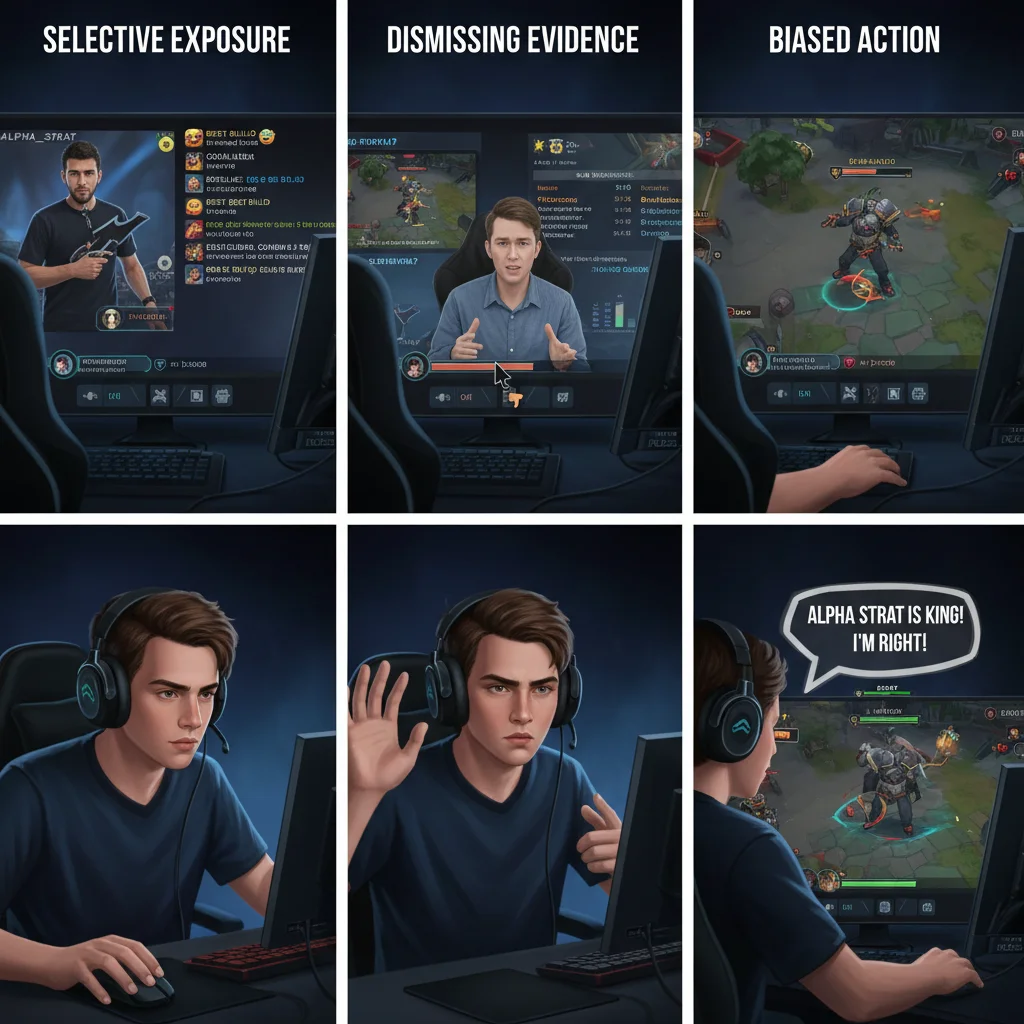
Confirmation Bias is the tendency to search for, interpret, favor, and recall information in a way that confirms one’s preexisting beliefs or hypotheses. In gaming, this means players often seek out evidence that supports their preferred strategies or opinions about game mechanics, while simultaneously ignoring or downplaying information that contradicts them. This can lead to a dangerously narrow perspective and an inability to adapt.
How it Manifests in Gaming:
- Selective Information Gathering: A gamer believes a certain hero is overpowered. They will actively seek out highlight reels showing that hero dominating, read forum posts agreeing with their view, and dismiss any statistics or professional opinions suggesting otherwise.
- Ignoring Counter-Evidence: During a match, a player might make a risky play that fails. Instead of recognizing the flaw in their decision, they attribute the failure to ‘luck’ or ‘bad teammates,’ reinforcing their belief that the play itself was correct.
- Interpreting Results Biasedly: After winning a game, a player might attribute the victory solely to their chosen strategy, even if other factors (like opponent mistakes or teammate performance) were more influential. Conversely, a loss is blamed on external factors rather than their own strategic shortcomings.
- Forming Opinionated Communities: Gamers often gravitate towards communities or content creators who share their specific views on game balance, meta, or strategies, creating an echo chamber where dissenting opinions are rarely encountered or quickly dismissed.
Why it’s Dangerous for US Gamers:
In the competitive gaming landscape of 2026, the meta is fluid and constantly evolving. Confirmation bias prevents US gamers from learning, adapting, and innovating. It creates blind spots, making players inflexible and predictable. If you’re only looking for information that validates what you already think, you’ll miss crucial insights that could lead to breakthroughs in your gameplay and strategy.
Overcoming Confirmation Bias:
- Actively Seek Disconfirming Evidence: Make a conscious effort to look for information that challenges your beliefs. Watch replays from the opponent’s perspective, read analyses that criticize your favorite strategies, or experiment with playstyles you initially dismiss.
- Practice Critical Self-Reflection: After every game, win or lose, ask yourself: “What did I do wrong? What could I have done better?” Attribute successes to good decisions and failures to poor ones, rather than external factors.
- Engage with Diverse Perspectives: Participate in discussions with players who hold different views. Listen actively and try to understand their reasoning, even if you disagree.
- Experiment and Test Hypotheses: Don’t just assume your strategy is best. Design controlled experiments in-game or during practice to objectively test different approaches and gather empirical data.
- Embrace the Scientific Method: Formulate a hypothesis (e.g., “Hero X is strong against Hero Y”), then actively try to prove it wrong. If you can’t, then your belief is stronger, but if you can, you’ve learned something valuable.
3. The Endowment Effect: Overvaluing Your Own Assets
The Endowment Effect describes our tendency to ascribe more value to things merely because we own them. In gaming, this bias can lead players to overvalue their own in-game resources, characters, or even their own life in a game, leading to suboptimal trades, hoarding, or missed opportunities. It’s about a distorted sense of ownership and worth.
How it Manifests in Gaming:
- Hoarding Resources: In strategy games, a player might hold onto valuable resources or powerful abilities for ‘just the right moment,’ which often never comes. They value their owned resources more than the potential benefits of spending them aggressively.
- Overvaluing a Specific Item: In an RPG or battle royale, a player might find a rare item. They then become overly protective of it, refusing to trade it for something more useful in the current situation or engaging in risky behaviors to preserve it, even if losing it means a greater overall setback.
- Reluctance to Trade Lives: In team-based combat games, a player might refuse to trade their ‘life’ (e.g., their character’s death) for a critical objective or a more valuable enemy target, even when such a trade would be highly advantageous for their team. They see their own life as more valuable than the collective gain.
- Refusing to Sell/Discard Old Gear: In games with inventories, players often cling to outdated or less effective gear because they ‘own’ it, even when selling it would provide gold for upgrades or discarding it would free up valuable inventory space.
Why it’s Dangerous for US Gamers:
Competitive gaming in 2026 demands precise resource management and calculated risks. The Endowment Effect can cripple a US gamer’s ability to make optimal decisions by clouding their judgment of true value. It leads to passive play, missed power spikes, and an inability to recognize when a sacrifice, even a seemingly costly one, is the best path to victory. This bias can manifest in minor ways, like holding onto a potion too long, or in major ways, like refusing to engage in a favorable team fight because of the perceived ‘cost’ of a potential death.
Overcoming the Endowment Effect:
- Adopt an Objective Value System: Before a game, understand the objective value of different resources, items, and even character lives in specific situations. What is a kill worth? What is an objective worth? What is the economic value of a particular item?
- Practice Calculated Risk-Taking: Actively look for opportunities where trading your ‘endowed’ asset (e.g., your character’s life) for a greater team objective or enemy resource is beneficial. Practice these trades in less critical scenarios.
- Think in Terms of Opportunity Cost: Instead of focusing on what you own, consider what you’re losing by not using or trading it. What opportunities are you missing by hoarding that ultimate ability or rare item?
- Regular Inventory/Resource Audit: Periodically review your in-game resources and items. Are they truly serving your current goals, or are you holding onto them out of a sense of attachment?
- Simulate Loss: Mentally prepare for the loss of certain assets. If you’re about to engage in a risky play, acknowledge that you might lose your character or a valuable item, and ensure the potential gain outweighs that loss.
4. The Availability Heuristic: Relying on Easily Recalled Information
The Availability Heuristic is a mental shortcut that relies on immediate examples that come to a given person’s mind when evaluating a specific topic, concept, method, or decision. In gaming, this means players often make decisions based on easily recalled, vivid, or recent experiences rather than a comprehensive, statistical understanding of probabilities and outcomes. This can lead to skewed perceptions of risk and reward.
How it Manifests in Gaming:
- Overestimating Low-Probability Events: A player might have once landed a miraculous, low-percentage shot or pulled off an improbable clutch play. Due to the vivid memory of this success, they will repeatedly attempt similar plays, despite their low success rate, overestimating their chances of repeating it.
- Underestimating Common Threats: Conversely, if a player hasn’t recently encountered a specific enemy strategy or character, they might underestimate its threat level, even if statistics or meta reports indicate it’s highly effective.
- Recency Bias in Patch Analysis: After a new game patch, players often overemphasize the impact of the most recent changes they’ve experienced or heard about, potentially overlooking more subtle but significant adjustments that haven’t yet produced a memorable outcome.
- Stereotyping Opponents: If a player has a few bad experiences with a particular character or playstyle (e.g., “all players who pick X character are toxic”), they might apply this generalization to all subsequent encounters, leading to biased decision-making against those opponents.
Why it’s Dangerous for US Gamers:
For US gamers striving for consistency in 2026, relying on the Availability Heuristic can be disastrous. Competitive gaming is often a game of probabilities and data. If you’re making decisions based on anecdotal evidence or what’s most easily recalled, you’re likely ignoring the true statistical likelihoods of success or failure. This leads to inconsistent performance, poor risk assessment, and an inability to adapt to the true meta, rather than just the meta you’ve recently encountered.
Overcoming the Availability Heuristic:
- Embrace Data and Statistics: Actively seek out and analyze objective data, patch notes, and professional statistics on game mechanics, character win rates, and strategy effectiveness. Prioritize data over personal anecdotes.
- Keep a Gaming Journal/Log: Document your experiences, successes, and failures, along with the context. This creates a broader, more balanced dataset for your own reference than just relying on vivid memories.
- Practice Deliberate Engagement: When making a decision, consciously consider all possible outcomes and their actual probabilities, rather than just the ones that immediately spring to mind.
- Vary Your Experiences: Play different characters, experiment with various strategies, and expose yourself to a wide range of opponents and playstyles. This broadens your mental database of experiences, making your ‘available’ information more diverse and representative.
- Challenge Your Assumptions: Before making a high-stakes play based on a ‘feeling’ or a past success, ask yourself: “What is the actual probability of this working? Am I overestimating my chances because of a vivid memory?”
The Path to Consistent Victories in 2026: A Mindset Shift
Overcoming these gaming cognitive biases is not a one-time fix; it’s an ongoing process of self-awareness, critical thinking, and deliberate practice. For US gamers looking to dominate in 2026, integrating psychological training into their regimen is as crucial as honing mechanical skills or mastering game knowledge. The meta is no longer just about what happens on screen, but what happens within the player’s mind.
By actively recognizing and neutralizing the Sunk Cost Fallacy, you empower yourself to adapt and cut losses when necessary. By battling Confirmation Bias, you open your mind to new strategies and crucial counter-information. By understanding the Endowment Effect, you learn to value assets objectively and make optimal trades. And by mitigating the Availability Heuristic, you ground your decisions in reality and data, not just vivid memories.
The journey to consistent victories is paved with self-improvement, and a significant portion of that path lies in understanding the intricacies of your own cognition. Start applying these strategies today, and watch as your gameplay transforms, leading you closer to your competitive goals in 2026 and beyond. The mental game is the ultimate frontier in esports, and mastering it will set you apart.